
** 1_在中文学校/Zài zhōngwén xuéxiào/En la escuela de chino/At the Chinese School **
** 额外内容/Contenido adicional/Additional Content **
** 家庭/Jiātíng/FAMILIA/FAMILY **

** 词汇/Cíhuì/VOCABULARIO/VOCABULARY. **
** 历史/Lìshǐ/La historia/history **
** 嘟嘟上学了/Dūdū shàngxué le/Dudú va a la escuela/Dudu Goes to School **
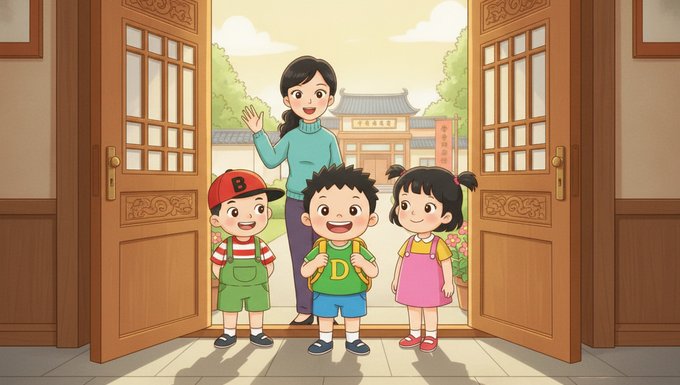
场景一/Chǎngjǐng yī/Escena 1/Scene 1
新学年开始了。今年, (Dudú) 也 (Estar en,en/Be at,in) 中文学校学习了!他背着新书包,高兴地说:‘我也是小学生了!’
Empezó el nuevo curso. ¡Este año (嘟嘟Dūdū) también estudia (在zài) la escuela de chino! Con su mochila nueva, dijo muy contento: ‘¡Yo también soy un alumno!’.
The new school year had begun. This year (嘟嘟Dūdū) was studying (在zài) the Chinese school too! With his new backpack on, he said happily, ‘I'm a schoolboy now too!’
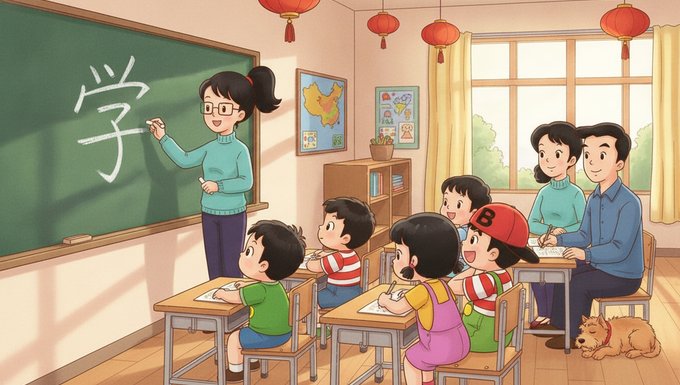
场景二/Chǎngjǐng èr/Escena 2/Scene 2
(Estar en,en/Be at,in) 中文学校,黄老师 (Enseñar/Teach) 大家 (Escribir/Write) (Caracteres chinos/Chinese characters) 。她 (Estar en,en/Be at,in) 黑板上 (Escribir/Write) 了一个大大的‘ (Dibujar/Draw) ’ (Carácter/Character) 。
(在zài) la escuela de chino, la profesora Huang les (教jiāo) a (写xiě) (汉字hànzì) . (在zài) la pizarra (写xiě) un (字zì) muy grande: el de (画huà) .
(在zài) the Chinese school, Teacher Huang (教jiāo) everyone to (写xiě) (汉字hànzì) . She (写xiě) a great big (字zì) on the blackboard: (画huà) .
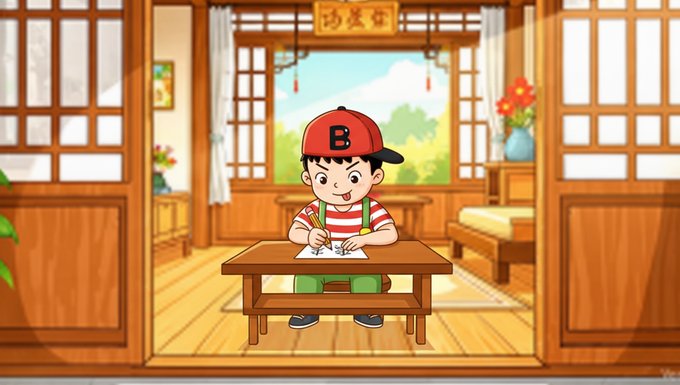
场景三/Chǎngjǐng sān/Escena 3/Scene 3
(Baobao) (Escribir/Write) 得很认真。他说:‘我 (Gustar/Like) (Escribir/Write) (Caracteres chinos/Chinese characters) !一个 (Carácter/Character) 一个 (Carácter/Character) 地 (Escribir/Write) ,真有意思。’
(宝宝Bǎobǎo) (写xiě) con mucho cuidado. Dijo: ‘¡Me (喜欢xǐhuan) (写xiě) (汉字hànzì) ! (写xiě) (字zì) a (字zì) es muy divertido’.
(宝宝Bǎobǎo) (写xiě) very carefully. He said, ‘I (喜欢xǐhuan) (写xiě) (汉字hànzì) ! (写xiě) them (字zì) by (字zì) is really fun.’
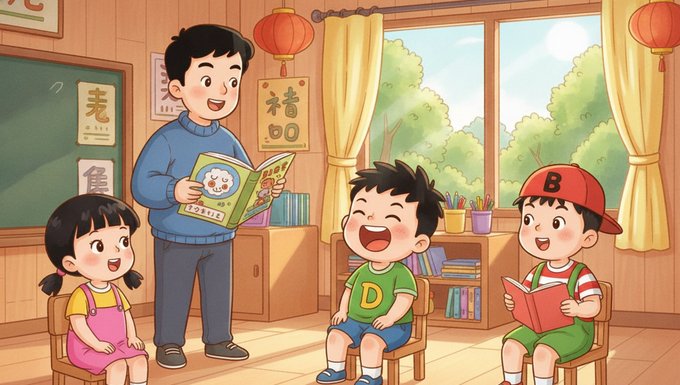
场景四/Chǎngjǐng sì/Escena 4/Scene 4
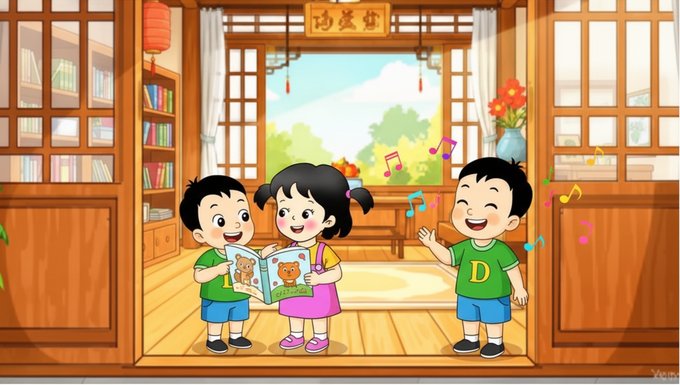
马老师 (Enseñar/Teach) 大家 (Leer/Read) (Canción infantil/Children's song) :‘中文学校真是好,小朋友们可不少……’ (Dudú) (Leer/Read) 得最大声。
El profesor Ma les (教jiāo) a (读dú) una (歌gē) infantil: ‘La escuela de chino es estupenda, hay muchísimos niños…’. (嘟嘟Dūdū) era el que (读dú) más alto.
Teacher Ma (教jiāo) everyone to (读dú) a children's (歌gē) : ‘The Chinese school is really great, there are lots of children…’ (嘟嘟Dūdū) (读dú) the loudest of all.
场景五/Chǎngjǐng wǔ/Escena 5/Scene 5
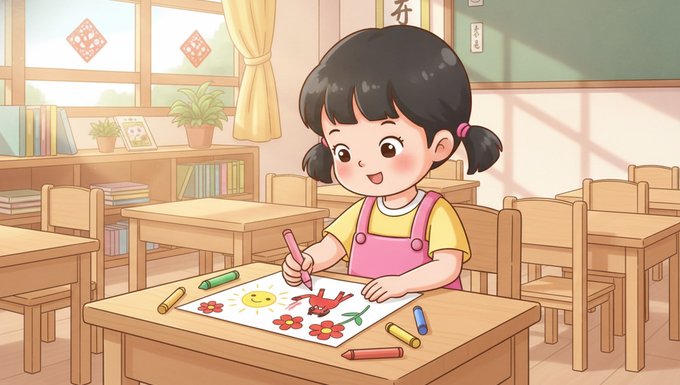
下课了, (Tíngting) (Estar en,en/Be at,in) 纸上 (Dibujar/Draw pictures) 。她 (Dibujar/Draw) 了太阳、小马和红花。 (Tíngting) 说:‘我最 (Gustar/Like) (Dibujar/Draw pictures) !’
En el recreo, (婷婷Tíngtíng) (画huà) (在zài) un papel. (画huà) el sol, un caballito y unas flores rojas. (婷婷Tíngtíng) dijo: ‘¡Lo que más me (喜欢xǐhuan) es (画huà) !’.
At break time, (婷婷Tíngtíng) (画huà) pictures (在zài) a piece of paper. She (画huà) the sun, a pony and red flowers. (婷婷Tíngtíng) said, ‘I (喜欢xǐhuan) (画huà) best of all!’
场景六/Chǎngjǐng liù/Escena 6/Scene 6
(Dudú) 问 (Tíngting) :‘姐姐,这个 (Carácter/Character) 怎么 (Leer/Read) ?’ (Tíngting) 说:‘这是‘ (Canción/Song) ’, (Cantar/Sing) 的‘ (Canción/Song) ’。’ (Dudú) 马上唱起 (Canción/Song) 来。
(嘟嘟Dūdū) le preguntó a (婷婷Tíngtíng) : ‘Hermana, ¿cómo se (读dú) este (字zì) ?’. (婷婷Tíngtíng) respondió: ‘Es (歌gē) , como en cantar una (歌gē) ’. Y (嘟嘟Dūdū) se puso a cantar enseguida.
(嘟嘟Dūdū) asked (婷婷Tíngtíng) , ‘Sister, how do you (读dú) this (字zì) ?’ (婷婷Tíngtíng) said, ‘It's (歌gē) , as in singing a (歌gē) .’ And (嘟嘟Dūdū) started singing straight away.
场景七/Chǎngjǐng qī/Escena 7/Scene 7
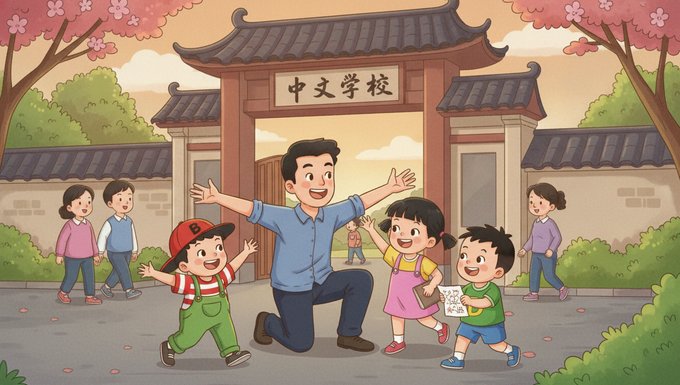
放学了, (Papá,padre/Dad,father) 来接他们。 (Papá,padre/Dad,father) 问:‘今天老师 (Enseñar/Teach) 你们什么了?’孩子们说:‘ (Escribir/Write) (Caracteres chinos/Chinese characters) 、 (Leer/Read) (Canción infantil/Children's song) 、 (Dibujar/Draw pictures) !’
Al terminar las clases, (爸爸Bàba) fue a recogerlos y preguntó: ‘¿Qué os han (教jiāo) hoy los profesores?’. Los niños respondieron: ‘¡A (写xiě) (汉字hànzì) , a (读dú) (儿歌érgē) infantiles y a (画huà) !’.
When school was over, (爸爸Bàba) came to pick them up. (爸爸Bàba) asked, ‘What did your teachers (教jiāo) you today?’ The children said, ‘To (写xiě) (汉字hànzì) , (读dú) children's (儿歌érgē) and (画huà) pictures!’
场景八/Chǎngjǐng bā/Escena 8/Scene 8
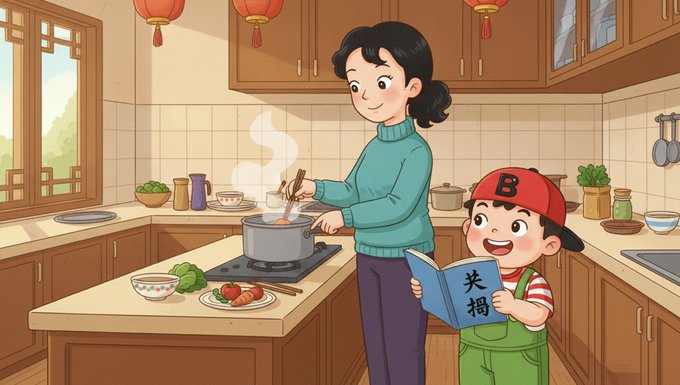
回到家, (Mamá,madre/Mom,mother) (Estar en,en/Be at,in) 厨房做饭。 (Baobao) 说:‘ (Mamá,madre/Mom,mother) ,我来 (Enseñar/Teach) 你 (Escribir/Write) (Caracteres chinos/Chinese characters) !’他 (Estar en,en/Be at,in) 本子上 (Escribir/Write) 了‘ (Mamá,madre/Mom,mother) ’两个 (Carácter/Character) 。
En casa, (妈妈Māmā) estaba cocinando (在zài) la cocina. (宝宝Bǎobǎo) dijo: ‘¡ (妈妈Māmā) , yo te (教jiāo) a (写xiě) (汉字hànzì) !’. Y (写xiě) (在zài) su cuaderno la palabra (妈妈Māmā) , con dos (字zì) .
Back home, (妈妈Māmā) was cooking (在zài) the kitchen. (宝宝Bǎobǎo) said, ‘ (妈妈Māmā) , I'll (教jiāo) you to (写xiě) (汉字hànzì) !’ And he (写xiě) the word (妈妈Māmā) (在zài) his notebook, with two (字zì) .
场景九/Chǎngjǐng jiǔ/Escena 9/Scene 9
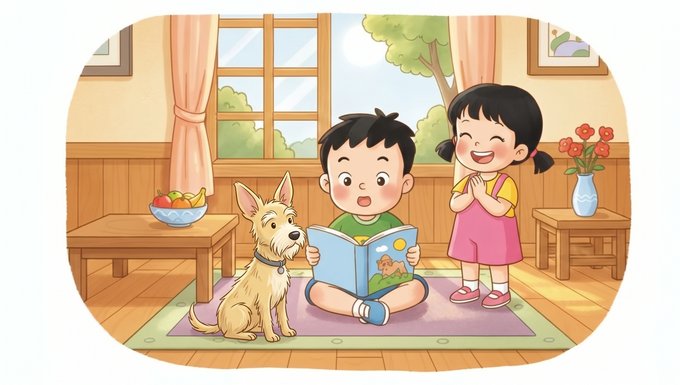
(Dudú) 拉着 (Rocky) ,给它 (Leer/Read) (Canción infantil/Children's song) 。 (Tíngting) 说:‘ (Rocky) 也 (Estar en,en/Be at,in) 学 (Idioma chino/Chinese language) 呢!’大家都笑了。
(嘟嘟Dūdū) se sentó con (洛基Luòjī) y le (读dú) una (歌gē) infantil. (婷婷Tíngtíng) dijo: ‘¡ (洛基Luòjī) también está aprendiendo (汉语Hànyǔ) !’. Todos se rieron.
(嘟嘟Dūdū) sat down with (洛基Luòjī) and (读dú) him a children's (歌gē) . (婷婷Tíngtíng) said, ‘ (洛基Luòjī) is learning (汉语Hànyǔ) too!’ Everyone laughed.
场景十/Chǎngjǐng shí/Escena 10/Scene 10
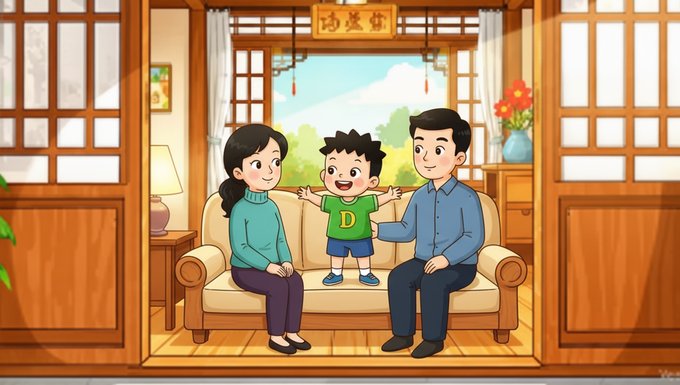
晚上, (Dudú) 对 (Papá,padre/Dad,father) (Mamá,madre/Mom,mother) 说:‘ (Nosotros/We) (Estar en,en/Be at,in) 中文学校学 (Idioma chino/Chinese language) 。我 (Gustar/Like) 中文学校!’
Por la noche, (嘟嘟Dūdū) les dijo a (爸爸Bàba) y (妈妈Māmā) : ‘ (我们wǒmen) aprendemos (汉语Hànyǔ) (在zài) la escuela de chino. ¡Me (喜欢xǐhuan) la escuela de chino!’.
In the evening, (嘟嘟Dūdū) said to (爸爸Bàba) and (妈妈Māmā) , ‘ (我们wǒmen) learn (汉语Hànyǔ) (在zài) the Chinese school. I (喜欢xǐhuan) the Chinese school!’
@ Zhongwen 资料 (SWF, PDF, MP3 等) 的版权归属于:中国华文教育网 - Overseas Chinese Language and Culture Education Online。
@ Los materiales Zhongwen (SWF, PDF, MP3, etc.) son propiedad de: 中国华文教育网 - Overseas Chinese Language and Culture Education Online.
@ The materials Zhongwen (SWF, PDF, MP3, etc.) are the property of: 中国华文教育网 - Overseas Chinese Language and Culture Education Online.

主题/Zhǔtí/Tema/Theme

其他/Qítā/Otros/Others.

阅读/Yuèdú/Lectura/Reading.

PDF与视频/PDF,videos Y Quiz/PDF, Videos and Quiz

额外内容/Contenido adicional/Additional Content
