
** 2_去书店/Qù shūdiàn/Ir a la librería/Going to the Bookstore **
** 额外内容/Contenido adicional/Additional Content **
** 家庭/Jiātíng/FAMILIA/FAMILY **

** 词汇/Cíhuì/VOCABULARIO/VOCABULARY. **
** 历史/Lìshǐ/La historia/history **
** 书店里的童话/Shūdiàn lǐ de tónghuà/Cuentos en la librería/Fairy Tales at the Bookstore **
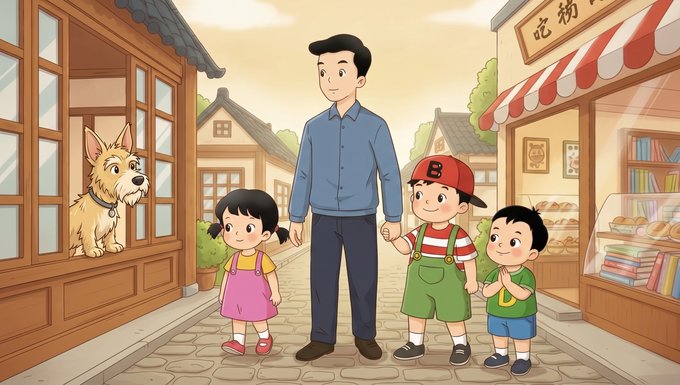
场景一/Chǎngjǐng yī/Escena 1/Scene 1
星期天上午, (Papá,padre/Dad,father) 带孩子们去 (Librería/Bookstore) 。 (Rocky) 在家里 (Esperar/Wait) 他们。
El domingo por la mañana, (爸爸Bàba) llevó a los niños a la (书店shūdiàn) . (洛基Luòjī) los (等děng) en casa.
On Sunday morning, (爸爸Bàba) took the children to the (书店shūdiàn) . (洛基Luòjī) (等děng) for them at home.
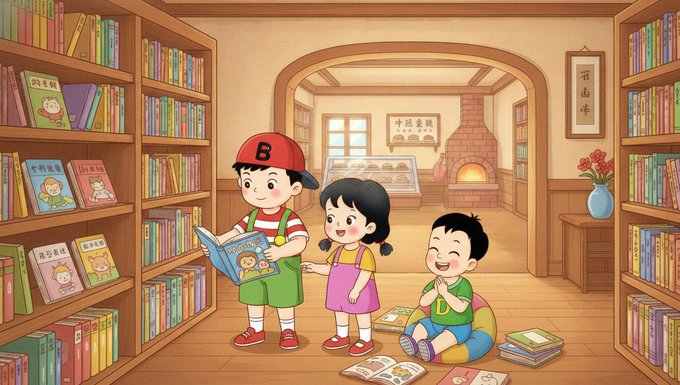
场景二/Chǎngjǐng èr/Escena 2/Scene 2
(Librería/Bookstore) 里的 (Niño,infantil/Child,children's) 书真多:有 (Cuento de hadas/Fairy tale) (Cuento,historia/Story) ,有 (Niño,infantil/Child,children's) (Revista ilustrada/Picture magazine) ,还有中文 (Libro de texto/Textbook) 。
En la (书店shūdiàn) había muchísimos libros (儿童értóng) : (童话tónghuà) , (画报huàbào) (儿童értóng) y también (课本kèběn) de chino.
There were so many (儿童értóng) books in the (书店shūdiàn) : (童话tónghuà) , (儿童értóng) (画报huàbào) and Chinese (课本kèběn) too.
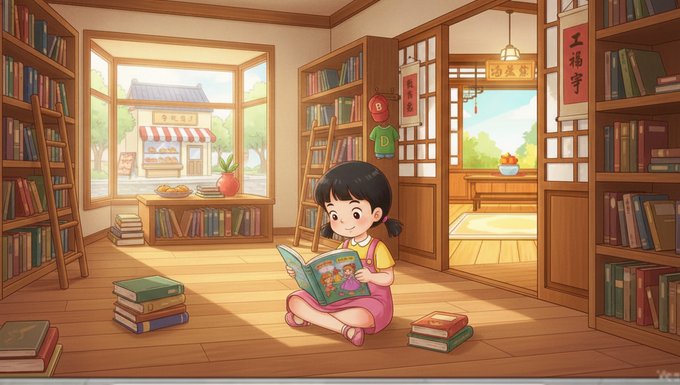
场景三/Chǎngjǐng sān/Escena 3/Scene 3
(Tíngting) (Coger,llevar en la mano/Take,hold) 了一本 (Andersen/Andersen) 的 (Cuento de hadas/Fairy tale) ,坐在地上看了起来。
(婷婷Tíngtíng) (拿ná) un libro de (童话tónghuà) de (安徒生Āntúshēng) , se sentó en el suelo y se puso a leer.
(婷婷Tíngtíng) (拿ná) a book of (安徒生Āntúshēng) 's (童话tónghuà) , sat on the floor and started reading.
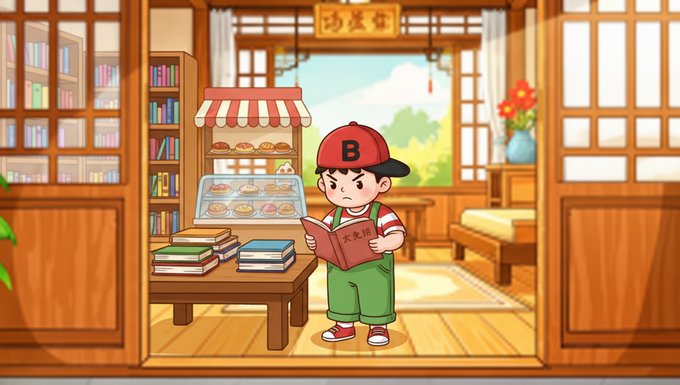
场景四/Chǎngjǐng sì/Escena 4/Scene 4
(Baobao) (Coger,llevar en la mano/Take,hold) 了一本中文 (Libro de texto/Textbook) 。他说:‘下星期 (Ir a clase/Attend class) ,我要用这本书。’
(宝宝Bǎobǎo) (拿ná) un (课本kèběn) de chino. Dijo: ‘La semana que viene, cuando vaya a (上课shàngkè) , usaré este libro’.
(宝宝Bǎobǎo) (拿ná) a Chinese (课本kèběn) . He said, ‘Next week, when I (上课shàngkè) , I'll use this book.’
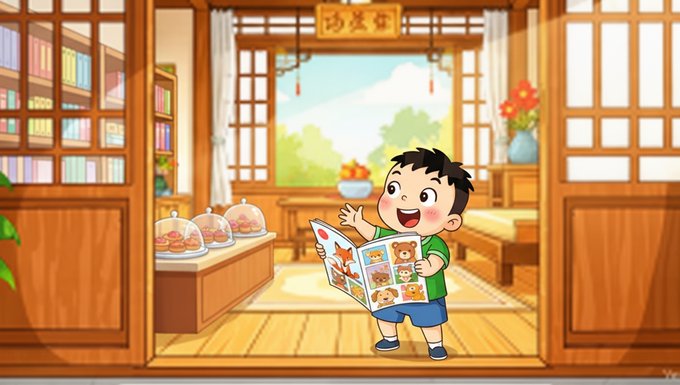
场景五/Chǎngjǐng wǔ/Escena 5/Scene 5
(Dudú) (Coger,llevar en la mano/Take,hold) 着一本 (Niño,infantil/Child,children's) (Revista ilustrada/Picture magazine) ,大声说:‘这本有很多小动物!’
(嘟嘟Dūdū) (拿ná) en la mano una (画报huàbào) (儿童értóng) y dijo en voz alta: ‘¡Esta tiene muchos animalitos!’.
(嘟嘟Dūdū) (拿ná) a (儿童értóng) (画报huàbào) and said loudly, ‘This one has lots of little animals!’
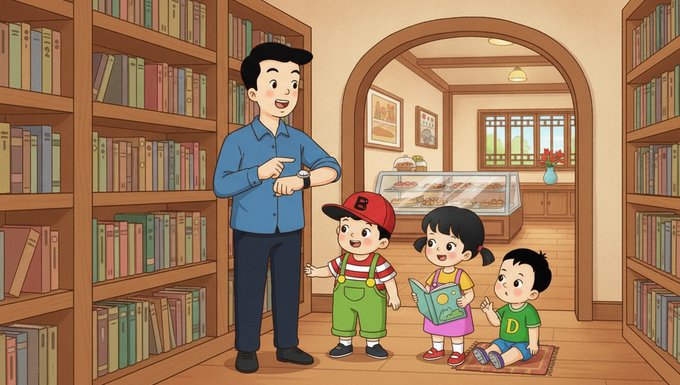
场景六/Chǎngjǐng liù/Escena 6/Scene 6
一会儿, (Papá,padre/Dad,father) 来叫他们:‘ (Ahora/Now) 十二点了, (Mamá,madre/Mom,mother) 在家 (Esperar/Wait) 我们 (Comer/Have a meal) 呢。’
Al rato, (爸爸Bàba) fue a llamarlos: ‘ (现在xiànzài) son las doce, (妈妈Māmā) nos está (等děng) en casa para (吃饭chīfàn) ’.
After a while, (爸爸Bàba) came to call them, ‘It's twelve o'clock (现在xiànzài) , (妈妈Māmā) is (等děng) for us at home to (吃饭chīfàn) .’
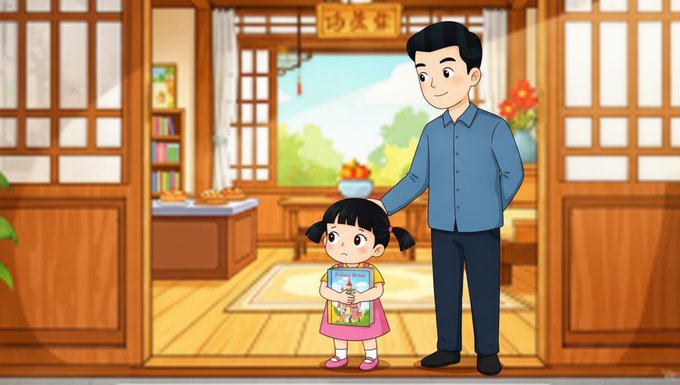
场景七/Chǎngjǐng qī/Escena 7/Scene 7
(Tíngting) 说:‘ (Papá,padre/Dad,father) ,我很喜欢 (Andersen/Andersen) 的 (Cuento de hadas/Fairy tale) (Cuento,historia/Story) ,给我买一本吧。’
(婷婷Tíngtíng) dijo: ‘ (爸爸Bàba) , me gustan mucho los (故事gùshi) de (安徒生Āntúshēng) , ¿me compras uno?’.
(婷婷Tíngtíng) said, ‘ (爸爸Bàba) , I really like (安徒生Āntúshēng) 's (故事gùshi) , please buy me one.’
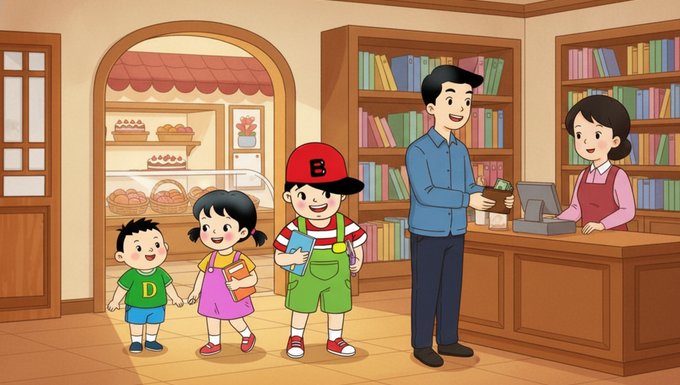
场景八/Chǎngjǐng bā/Escena 8/Scene 8
(Papá,padre/Dad,father) (Coger,llevar en la mano/Take,hold) 出 (Cartera,monedero/Wallet) 去 (Pagar/Pay) 。三个孩子 (Coger,llevar en la mano/Take,hold) 着新书,高高兴兴地走出了 (Librería/Bookstore) 。
(爸爸Bàba) sacó la (钱包qiánbāo) y fue a (付钱fùqián) . Los tres niños, con sus libros nuevos en la mano, salieron muy contentos de la (书店shūdiàn) .
(爸爸Bàba) took out his (钱包qiánbāo) and went to (付钱fùqián) . The three children, holding their new books, happily walked out of the (书店shūdiàn) .
场景九/Chǎngjǐng jiǔ/Escena 9/Scene 9
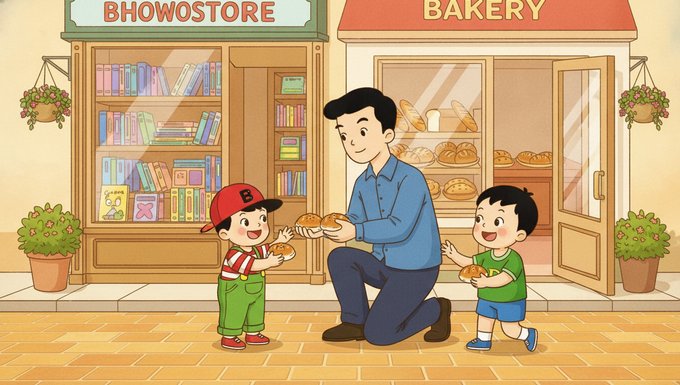
(Librería/Bookstore) 旁边有一家 (Panadería/Bakery) 。 (Dudú) 说:‘我饿了!’ (Papá,padre/Dad,father) 给每人买了一个小面包。
Al lado de la (书店shūdiàn) había una (面包店miànbāodiàn) . (嘟嘟Dūdū) dijo: ‘¡Tengo hambre!’. (爸爸Bàba) compró un panecillo para cada uno.
Next to the (书店shūdiàn) there was a (面包店miànbāodiàn) . (嘟嘟Dūdū) said, ‘I'm hungry!’ (爸爸Bàba) bought a little bun for each of them.
场景十/Chǎngjǐng shí/Escena 10/Scene 10
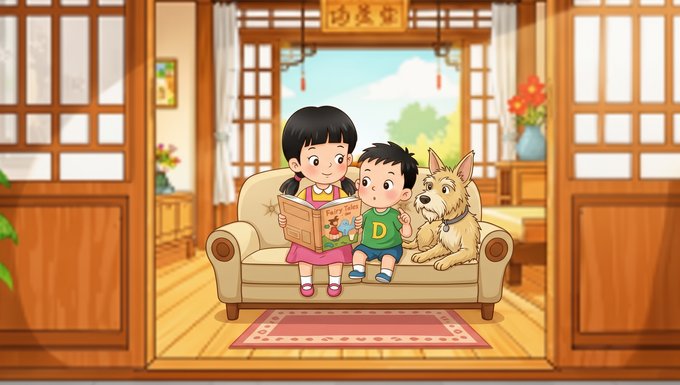
回到家,吃完饭, (Tíngting) 给弟弟讲 (Cuento de hadas/Fairy tale) (Cuento,historia/Story) 。 (Rocky) 也趴在旁边听。
Al llegar a casa, después de comer, (婷婷Tíngtíng) le contó a su hermanito un (童话tónghuà) . (洛基Luòjī) también se tumbó a su lado a escuchar.
Back home, after lunch, (婷婷Tíngtíng) told her little brother a (童话tónghuà) . (洛基Luòjī) lay beside them and listened too.
@ Zhongwen 资料 (SWF, PDF, MP3 等) 的版权归属于:中国华文教育网 - Overseas Chinese Language and Culture Education Online。
@ Los materiales Zhongwen (SWF, PDF, MP3, etc.) son propiedad de: 中国华文教育网 - Overseas Chinese Language and Culture Education Online.
@ The materials Zhongwen (SWF, PDF, MP3, etc.) are the property of: 中国华文教育网 - Overseas Chinese Language and Culture Education Online.

主题/Zhǔtí/Tema/Theme

其他/Qítā/Otros/Others.

阅读/Yuèdú/Lectura/Reading.

PDF与视频/PDF,videos Y Quiz/PDF, Videos and Quiz

额外内容/Contenido adicional/Additional Content
