** 06_他是谁/tā shì shéi/¿Quién es él?/Who is he? **

点击放大/clic para ampliar/click to enlarge

点击放大/clic para ampliar/click to enlarge

AVI: 词汇/Vocabulario/Vocabulary
** 词汇/cí huì/Vocabulario/Vocabulary **
1) 他tā是shì谁shéi/¿Quién es él?/Who is he?

点击放大/clic para ampliar/click to enlarge
中文/Chino/Chinese
西班牙语/Español/Spanish
英语/inglés/English
2) 他tā是shì宝宝Bǎobao/Él es Bao Bao/He is Bao Bao

点击放大/clic para ampliar/click to enlarge
中文/Chino/Chinese
西班牙语/Español/Spanish
英语/inglés/English
3) 丽达Lìdá/Lida (nombre propio)/Lida (proper name)

点击放大/clic para ampliar/click to enlarge
中文/Chino/Chinese
西班牙语/Español/Spanish
英语/inglés/English
4) 丽丽Lìli/Lily (nombre propio)/Lily (proper name)

点击放大/clic para ampliar/click to enlarge
中文/Chino/Chinese
西班牙语/Español/Spanish
英语/inglés/English
5) 静子Jìngzi/Jingzi (nombre propio)/Jingzi (proper name)

点击放大/clic para ampliar/click to enlarge
中文/Chino/Chinese
西班牙语/Español/Spanish
英语/inglés/English
6) 汤姆Tāngmǔ/Tom (nombre propio)/Tom (proper name)

点击放大/clic para ampliar/click to enlarge
中文/Chino/Chinese
西班牙语/Español/Spanish
英语/inglés/English
7) 提tí/Trazo ascendente/Rising stroke

点击放大/clic para ampliar/click to enlarge
中文/Chino/Chinese
西班牙语/Español/Spanish
英语/inglés/English
** 部首/bù shǒu/Radical/Radical **
中文
Español
English
点击放大/clic para ampliar/click to enlarge
中文
Español
English
▶ 📝 评论 / Comentarios / Comments
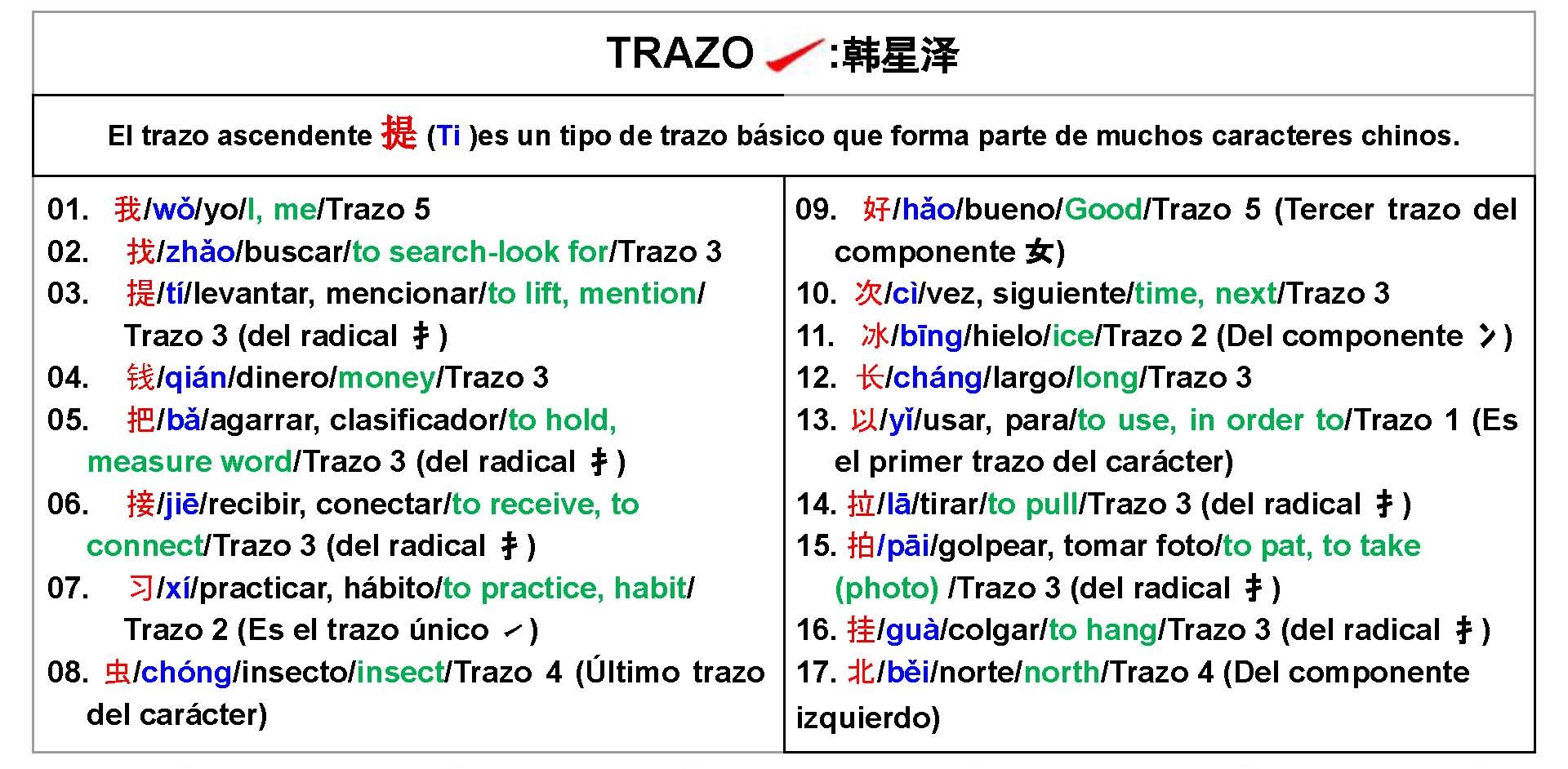
2. 作为独立笔画 (㇀):在 习 (xí) 和 以 (yǐ) 中,“提”是主要笔画,且一笔写成。
3. 作为其他笔画的末端部分:在“我”、“找”、“虫”和“长”中,“提”是更复杂笔画末尾向上的部分 (例如由横变提)。
4. 在偏旁部首中:在 钱 (qián) 中,“提”在金字旁 (钅) 里;在 冰 (bīng) 中,“提”在两点水 (冫) 里。
2. Como trazo independiente (㇀): En 习 (xí) y 以 (yǐ), el ‘提’ es el trazo principal y se escribe de una sola vez.
3. Parte final de otro trazo: En 我, 找, 虫 y 长, el ‘提’ es la parte final ascendente de un trazo más complejo (como un héng horizontal que se convierte en tí).
4. En componentes como radical: En 钱 (qián), el ‘提’ está en el componente 钅; en 冰 (bīng), está en el componente 冫.
2. As an independent stroke (㇀): In 习 (xí) and 以 (yǐ), the ‘提’ is the main stroke and is written in one continuous motion.
3. As the final part of another stroke: In 我, 找, 虫, and 长, the ‘提’ is the final ascending part of a more complex stroke (such as a horizontal héng that becomes a tí).
4. In components as a radical: In 钱 (qián), the ‘提’ is in the 钅 component; in 冰 (bīng), it is in the 冫 component.
8) 他tā(她(tā))是shì谁shéi/¿Quién es él (ella)?/Who is he (she)?

点击放大/clic para ampliar/click to enlarge
中文/Chino/Chinese
西班牙语/Español/Spanish
英语/inglés/English
** 字/zì/Caracteres/Characters **
(次/veces/times:1,2,3,4,5,6,7,8,9)
了解更多信息,请点击汉字。 Para más información clik en el Hanzi. For more information, click on the Hanzi.
汉字的音频/Audio de los Hanzi/Audio of the Hanzi
** 词汇/cí huì/Vocabulario/Vocabulary **
AVI: 词汇/Vocabulario/Vocabulary
中文/Chino/Chinese
西班牙语/Español/Spanish
英语/inglés/English

AVI: 听与重复/Escucha y repite/Listen and repeat
▶ 📝 评论 / Comentarios / Comments
2. 笔画 提 (tí):拼音中已添加了必不可少的第二声(阳平)。
2. El trazo 提 (tí): Se ha añadido el segundo tono en el pinyin, que es obligatorio.
2. The stroke 提 (tí): The second tone has been added to the pinyin, which is mandatory.
** 目录/mù lù/Indice de la página/Table of contents **
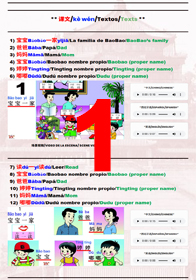
课文/Textos/Texts
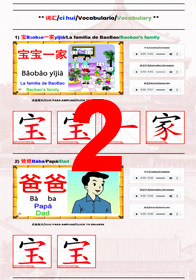
词汇/Vocabulario/Vocabulary
补充材料/Materiales adicionales/Additional Materials

PDF与视频/PDF y videos/PDF and Videos
边玩边学/Aprenda jugando/Learn by Playing
学习西班牙语/Aprenda Español/Learn Spanish
