** 08_她是我妈妈/Tā shì wǒ māmā/Ella es mi madre/She is my mom **

课程视频/VIDEO DE LA LECCION/Lesson video
** 课文/kè wén/Textos/Texts **
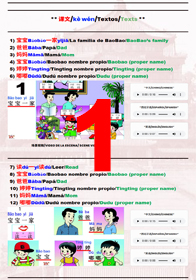
1) 她Tā是shì我wǒ妈妈māma/Ella es mi madre/She is my mom
2) 她Tā是shì你nǐ妈妈māma吗ma?/¿Es ella tu madre?/Is she your mom?
3) 她Tā是shì我wǒ妈妈māma/Ella es mi madre/She is my mom

场景视频/Video de la escena/ Scene video
中文/Chino/Chinese
西班牙语/Español/Spanish
英语/inglés/English
4) 读dú一yi读dú/Lee un poco/Read a bit
5) 她Tā是shì我wǒ妈妈māma/Ella es mi madre/She is my mom
6) 爸爸bàba/Papá/Dad
7) 妈妈māma/Mamá/Mom
8) 弟弟dìdi/Hermano menor/Younger brother
9) 妹妹mèimei/Hermana menor/Younger sister

中文/Chino/Chinese
西班牙语/Español/Spanish
英语/inglés/English
10) 他Tā是shì我wǒ爸爸bàba/Él es mi padre/He is my dad

中文/Chino/Chinese
西班牙语/Español/Spanish
英语/inglés/English
11) 她Tā是shì我wǒ妈妈māma/Ella es mi madre/She is my mom

中文/Chino/Chinese
西班牙语/Español/Spanish
英语/inglés/English
12) 他Tā是shì我wǒ弟弟dìdi/Él es mi hermano menor/He is my younger brother

中文/Chino/Chinese
西班牙语/Español/Spanish
英语/inglés/English
13) 她Tā是shì我wǒ妹妹mèimei/Ella es mi hermana menor/She is my younger sister

中文/Chino/Chinese
西班牙语/Español/Spanish
英语/inglés/English
14) 说shuō一yi说shuō/Habla un poco/Practice speaking
15) A:她Tā是shì你nǐ妈妈māma吗ma?/¿Es ella tu madre?/Is she your mom?
16) B:她Tā是shì我wǒ妈妈māma/Ella es mi madre/She is my mom

中文/Chino/Chinese
西班牙语/Español/Spanish
英语/inglés/English
17) A:她Tā是shì你nǐ妈妈māma吗ma?/¿Es ella tu madre?/Is she your mom?
18) B:她Tā是shì我wǒ妈妈māma/Ella es mi madre/She is my mom

中文/Chino/Chinese
西班牙语/Español/Spanish
英语/inglés/English
19) A:他Tā是shì你nǐ爸爸bàba吗ma?/¿Es él tu padre?/Is he your dad?
20) B:他Tā是shì我wǒ爸爸bàba/Él es mi padre/He is my dad

中文/Chino/Chinese
西班牙语/Español/Spanish
英语/inglés/English
21) A:他Tā是shì你nǐ弟弟dìdi吗ma?/¿Es él tu hermano menor?/Is he your younger brother?
22) B:他Tā是shì我wǒ弟弟dìdi/Él es mi hermano menor/He is my younger brother

中文/Chino/Chinese
西班牙语/Español/Spanish
英语/inglés/English
23) A:她Tā是shì你nǐ妹妹mèimei吗ma?/¿Es ella tu hermana menor?/Is she your younger sister?
24) B:她Tā是shì我wǒ妹妹mèimei/Ella es mi hermana menor/She is my younger sister

中文/Chino/Chinese
西班牙语/Español/Spanish
英语/inglés/English
25) 写xiě一yi写xiě/Escribe un poco/Write a bit
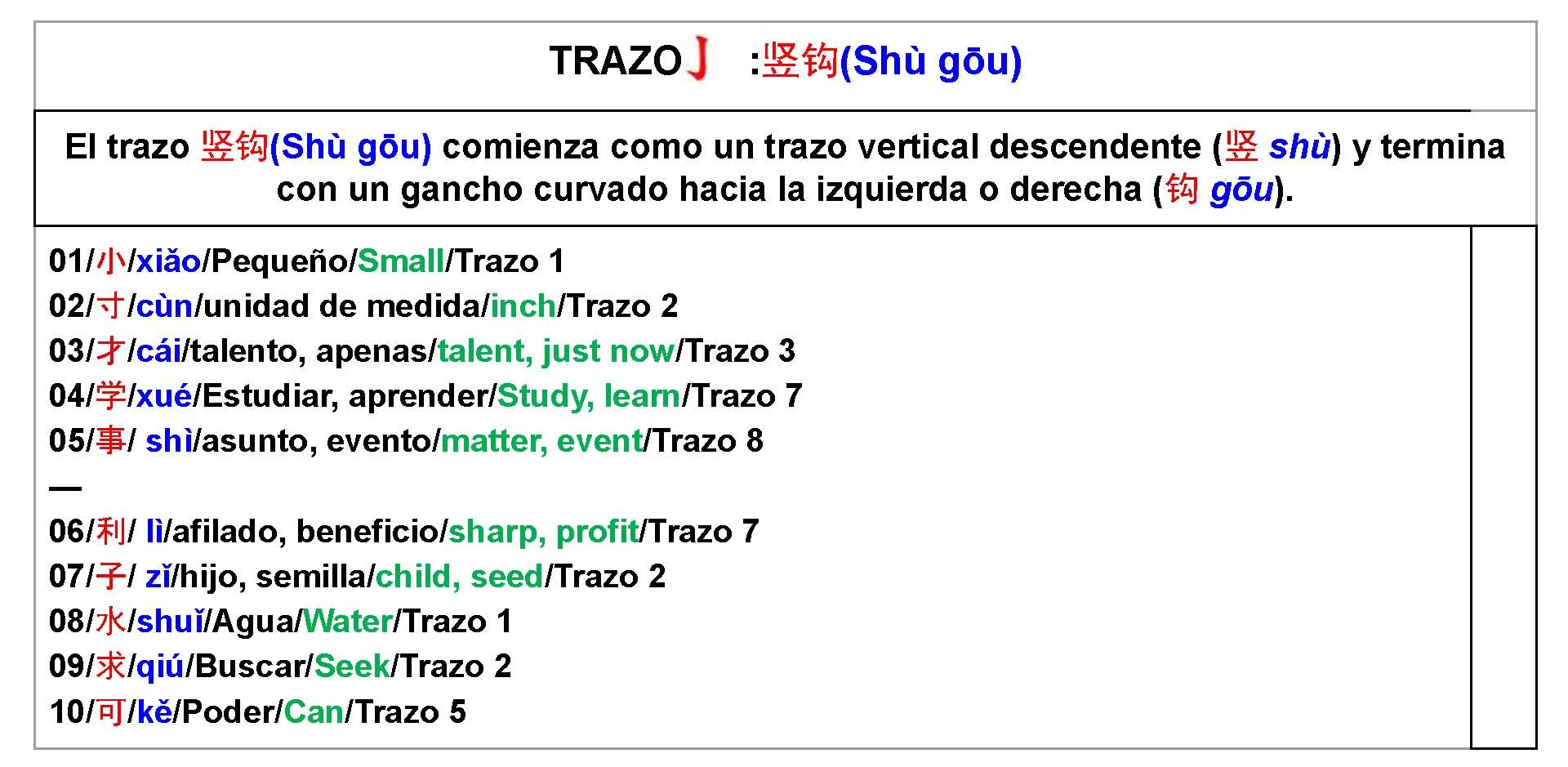
26) 竖钩shùgōu/Trazo vertical con gancho/Vertical hook stroke

中文/Chino/Chinese
西班牙语/Español/Spanish
英语/inglés/English
27) 课堂kètáng活动huódòng/Actividades en clase/Classroom activities
28) 过guò家家jiājia/Jugar a la casita/House play

中文/Chino/Chinese
西班牙语/Español/Spanish
英语/inglés/English
29) 儿歌érgē/Canción infantil/Nursery rhyme
30) 拍pāi皮球píqiú/Botar la pelota/Bounce the ball

中文/Chino/Chinese
西班牙语/Español/Spanish
英语/inglés/English
** 部首/bù shǒu/Radical/Radical **
点击放大/clic para ampliar/click to enlarge
中文
Español
English
▶ 📝 评论 / Comentarios / Comments
2. 汉字的“锚”: 在视觉上,这个笔画就像一个锚或中心柱,赋予汉字稳定性和对称性。它经常将空间平分,如在 小 (xiǎo,小) 或 水 (shuǐ,水) 中。
3. 钩的方向: 必须牢记,在标准的 竖钩 (shùgōu) 中,钩总是指向 左边。存在另一种钩向右的相似笔画,但名称不同,因此这里的方向至关重要。
4. 笔顺规则(先中间后两边): 当这个笔画作为对称汉字的中心轴时 (如在 小 或 水 中),适用一条新的书写规则:“先中间后两边” (先中间后两边 - xiān zhōngjiān hòu liǎngbiān) 。因此,竖钩 (shùgōu) 要最先写,然后再写两边的笔画。
2. El ancla del carácter: Visualmente, este trazo funciona como el ancla o el poste central que da estabilidad y simetría al carácter. Es muy común verlo dividiendo el espacio en partes iguales, como en los caracteres 小 (pequeño) o 水 (agua) .
3. Dirección del gancho: Es crucial recordar que en el shùgōu estándar, el gancho siempre apunta hacia la izquierda. Existe otro trazo similar donde el gancho va hacia la derecha, pero tiene un nombre distinto, por lo que la dirección aquí es muy importante.
4. Regla del orden de los trazos (primero el centro): Cuando este trazo actúa como el eje central de un carácter simétrico (como en 小 o 水) , se aplica una nueva regla de escritura: ‘primero el centro, luego los lados’ (先中间后两边 - xiān zhōngjiān hòu liǎngbiān) . Por lo tanto, el shùgōu se escribe primero antes de añadir los trazos laterales.
2. The anchor of the character: Visually, this stroke acts as the anchor or central pillar that gives stability and symmetry to the character. It is very common to see it dividing the space into equal parts, as in the characters 小 (small) or 水 (water) .
3. Direction of the hook: It is crucial to remember that in the standard shùgōu, the hook always points to the left. There is another similar stroke where the hook goes to the right, but it has a different name, so the direction here is very important.
4. Stroke order rule (center first): When this stroke acts as the central axis of a symmetrical character (as in 小 or 水), a new writing rule applies: ‘center first, then sides’ (先中间后两边 - xiān zhōngjiān hòu liǎngbiān) . Therefore, the shùgōu is written first before adding the side strokes.
** 字符/zìfú/caracteres/characters **

AVI: 书写汉字/Escribir caracteres/ Writing Chinese characters
▶ 📝 评论 / Comentarios / Comments
2. 弟 (dì):通常以 弟弟 (弟弟) 的形式出现。
3. 妹 (mèi):通常以 妹妹 (妹妹) 的形式出现。
4. 过 (guò):有两个主要用法。作为动词意为 “穿过” 或 “经过”(HSK 2)。作为语法助词表示经历过某事(HSK 4)。例如:我去过西班牙 (Wǒ qùguo Xībānyá) - 我去过西班牙。
5. 拍 (pāi):其含义会根据搭配而变化。拍球 (pāi qiú) 是拍皮球,而 拍照 (pāi zhào) 是照相。有趣的是,在前面课程的语境 (拍皮球) 中,这个动词的意思是用手 “拍打”,因为它的字面意思是张开手掌击打。
6. 儿 (ér):作为单独的汉字意思是 “儿子” 或 “孩子”,读作二声 (ér) 。它也可以作为 “后缀”,这与前面课程中学过的 儿化音 现象完美契合(在这种情况下失去原调,变成一个 r 音)。
2. 弟 (dì): Normalmente aparece como 弟弟 (hermano menor) .
3. 妹 (mèi): Normalmente aparece como 妹妹 (hermana menor) .
4. 过 (guò): Tiene dos usos principales. Como verbo significa ‘cruzar’ o ‘pasar’ (HSK 2). Como partícula gramatical indica que se ha tenido una experiencia (HSK 4). Ej: 我去过西班牙 (Wǒ qùguo Xībānyá) - He ido a España.
5. 拍 (pāi): Su significado cambia según la palabra que le acompañe. 拍球 (pāi qiú) es botar una pelota, pero 拍照 (pāi zhào) es tomar una foto. Como dato curioso, en el contexto de la lección anterior (拍皮球), este verbo adquiere el sentido de ‘botar’ (una pelota con la mano) , ya que literalmente significa golpear algo con la palma abierta.
6. 儿 (ér): Como carácter individual significa ‘hijo’ o ‘niño’ y se pronuncia en segundo tono (ér) . También actúa como ‘sufijo’, ya que conecta perfectamente con la lección anterior sobre el fenómeno Erhua (donde pierde el tono y se vuelve solo una r).
2. 弟 (dì): Usually appears as 弟弟 (younger brother) .
3. 妹 (mèi): Usually appears as 妹妹 (younger sister) .
4. 过 (guò): It has two main uses. As a verb, it means ‘to cross’ or ‘to pass’ (HSK 2). As a grammatical particle, it indicates having experienced something (HSK 4). Ex: 我去过西班牙 (Wǒ qùguo Xībānyá) - I have been to Spain.
5. 拍 (pāi): Its meaning changes depending on the context. 拍球 (pāi qiú) is to bounce a ball, but 拍照 (pāi zhào) is to take a picture. Interestingly, in the context of the previous lesson (拍皮球), this verb takes on the meaning of ‘to bounce’ (a ball with the hand) , as it literally means to strike something with an open palm.
6. 儿 (ér): As an individual character, it means ‘son’ or ‘child’ and is pronounced in the second tone (ér) . It also acts as a ‘suffix’, connecting perfectly with the Erhua phenomenon from the previous lesson (where it loses its tone and becomes just an r).
** 词汇/cí huì/Vocabulario/Vocabulary **

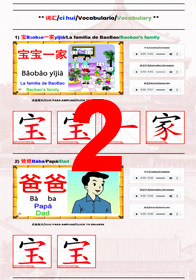
AVI: 词汇/Vocabulario/Vocabulary
中文/Chino/Chinese
西班牙语/Español/Spanish
英语/inglés/English

AVI: 听与重复/Escucha y repite/Listen and repeat
▶ 📝 评论 / Comentarios / Comments
2. 轻声:正如我们之前解释过的,家庭成员 (dìdi, mèimei) 和 “家” (jiājia) 的第二个音节不带声调符号。
3. 领属助词 (的 - de):领属助词 “的” 使得这些词既可以作为定语修饰名词 (如“我的书” / my),也可以作为代词单独使用 (如“是我的” / mine) 。
2. Tonos neutros: La segunda sílaba de los miembros de la familia (dìdi, mèimei) y de ‘casa’ (jiājia) no lleva marca de tono, tal como explicamos anteriormente.
3. Posesivos (的 - de): La partícula posesiva ‘的’ permite que estas palabras funcionen tanto acompañando a un sustantivo (‘mi libro’ / my) como sustituyéndolo (‘es mío’ / mine) .
2. Neutral tones: The second syllable of family members (dìdi, mèimei) and ‘house/home’ (jiājia) does not carry a tone mark, just as we explained previously.
3. Possessives (的 - de): The possessive particle ‘的’ allows these words to function both accompanying a noun (‘my book’ / my) and replacing it (‘it is mine’ / mine) .
** 目录/mù lù/Indice de la página/Table of contents **
课文/Textos/Texts
词汇/Vocabulario/Vocabulary
补充材料/Materiales adicionales/Additional Materials

PDF与视频/PDF y videos/PDF and Videos
边玩边学/Aprenda jugando/Learn by Playing
学习西班牙语/Aprenda Español/Learn Spanish
