** 06_他是谁/tā shì shéi/¿Quién es él?/Who is he? **

课程视频/VIDEO DE LA LECCION/Lesson video
** 课文/kè wén/Textos/Texts **
1) 他tā是shì谁shéi/¿Quién es él?/Who is he?
2) 他tā是shì谁shéi/¿Quién es él?/Who is he?
3) 他tā是shì宝宝Bǎobao/Él es Bao Bao/He is Bao Bao

场景视频/Video de la escena/ Scene video
中文/Chino/Chinese
西班牙语/Español/Spanish
英语/inglés/English
4) 读dú一yi读dú/Lee un poco/Read a bit
5) 他tā(她(tā))是shì……/Él (ella) es.../He (she) is...
6) 丽达Lìdá/Lida(nombre propio)/Lida (proper name)
7) 丽丽Lìli/Lily(nombre propio)/Lily (proper name)
8) 静子Jìngzi/Jingzi(nombre propio)/Jingzi (proper name)
9) 汤姆Tāngmǔ/Tom(nombre propio)/Tom (proper name)

中文/Chino/Chinese
西班牙语/Español/Spanish
英语/inglés/English
10) 她tā是shì丽达Lìdá/Ella es Lida/She is Lida

中文/Chino/Chinese
西班牙语/Español/Spanish
英语/inglés/English
11) 她tā是shì丽丽Lìli/Ella es Lily/She is Lily

中文/Chino/Chinese
西班牙语/Español/Spanish
英语/inglés/English
12) 她tā是shì静子Jìngzi/Ella es Jingzi/She is Jingzi

中文/Chino/Chinese
西班牙语/Español/Spanish
英语/inglés/English
13) 他tā是shì汤姆Tāngmǔ/Él es Tom/He is Tom

中文/Chino/Chinese
西班牙语/Español/Spanish
英语/inglés/English
14) 说shuō一yi说shuō/Habla un poco/Practice speaking
15) 他tā是shì谁shéi/¿Quién es él?/Who is he?
16) 他tā是shì宝宝Bǎobao/Él es Bao Bao/He is Bao Bao

中文/Chino/Chinese
西班牙语/Español/Spanish
英语/inglés/English
17) A:她Tā是shì谁shéi/¿Quién es ella?/Who is she?
18) B:她Tā是shì静子Jìngzi/Ella es Jingzi/She is Jingzi

中文/Chino/Chinese
西班牙语/Español/Spanish
英语/inglés/English
19) A:她Tā是shì谁shéi/¿Quién es ella?/Who is she?
20) B:她Tā是shì丽达Lìdá/Ella es Lida/She is Lida

中文/Chino/Chinese
西班牙语/Español/Spanish
英语/inglés/English
21) A:他Tā是shì谁shéi/¿Quién es él?/Who is he?
22) B:他Tā是shì汤姆Tāngmǔ/Él es Tom/He is Tom

中文/Chino/Chinese
西班牙语/Español/Spanish
英语/inglés/English
23) A:她Tā是shì谁shéi/¿Quién es ella?/Who is she?
24) B:她Tā是shì丽丽Lìli/Ella es Lily/She is Lily

中文/Chino/Chinese
西班牙语/Español/Spanish
英语/inglés/English
25) 写xiě一yi写xiě/Escribe un poco/Write a bit
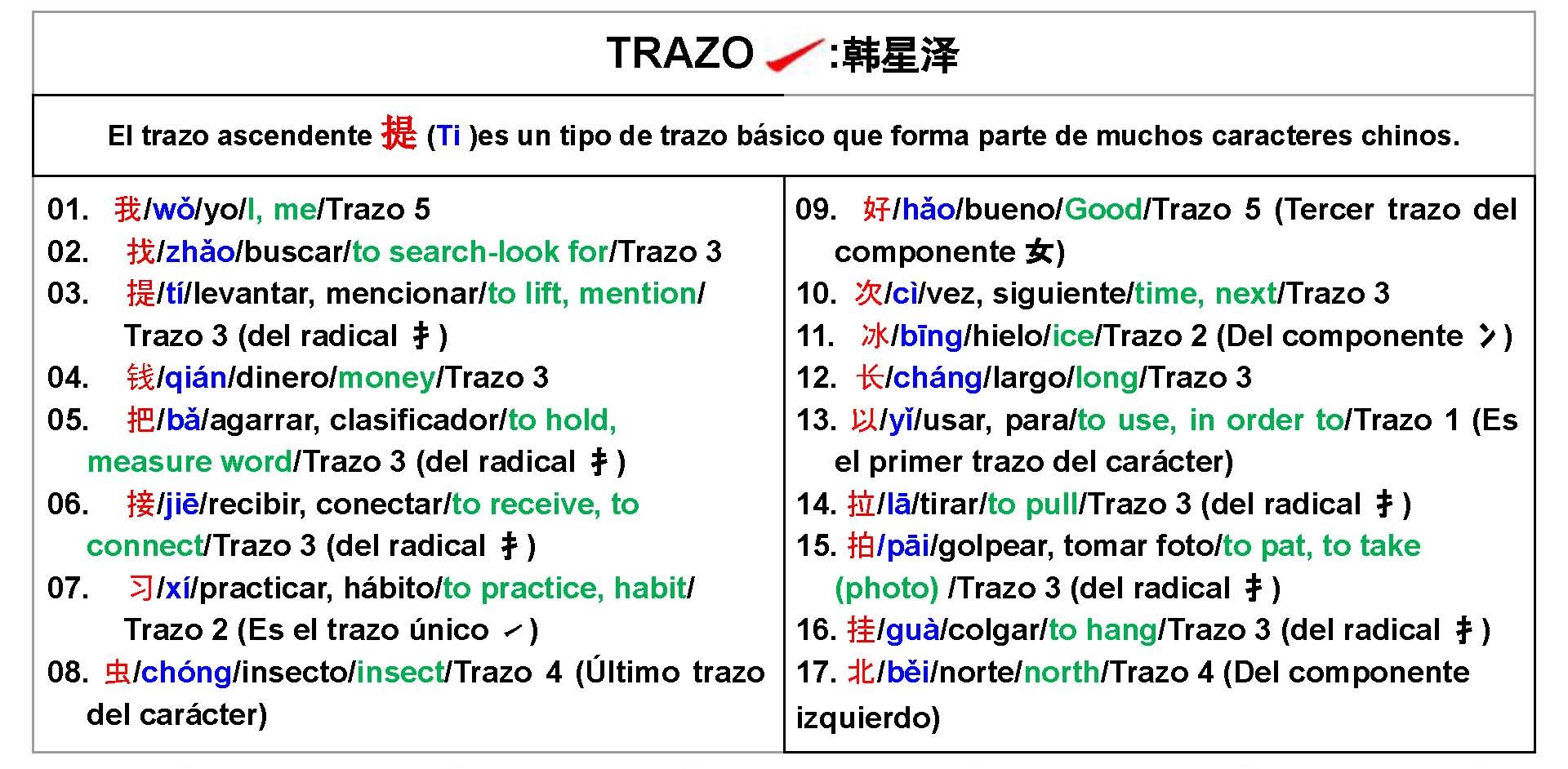
26) 提tí/Trazo ascendente/Rising stroke

中文/Chino/Chinese
西班牙语/Español/Spanish
英语/inglés/English
27) 课堂kètáng活动huódòng/Actividades en clase/Classroom activities
28) 他tā(她(tā))是shì谁shéi/¿Quién es él (ella)?/Who is he (she)?

中文/Chino/Chinese
西班牙语/Español/Spanish
英语/inglés/English
29) 儿歌érgē/Canción infantil/Nursery rhyme
30) 小手xiǎoshǒu的de话huà/Lo que dicen las manitas/What the little hands say

中文/Chino/Chinese
西班牙语/Español/Spanish
英语/inglés/English
** 部首/bù shǒu/Radical/Radical **
中文
Español
English
点击放大/clic para ampliar/click to enlarge
中文
Español
English
▶ 📝 评论 / Comentarios / Comments
2. 作为独立笔画 (㇀):在 习 (xí) 和 以 (yǐ) 中,“提”是主要笔画,且一笔写成。
3. 作为其他笔画的末端部分:在“我”、“找”、“虫”和“长”中,“提”是更复杂笔画末尾向上的部分 (例如由横变提)。
4. 在偏旁部首中:在 钱 (qián) 中,“提”在金字旁 (钅) 里;在 冰 (bīng) 中,“提”在两点水 (冫) 里。
2. Como trazo independiente (㇀): En 习 (xí) y 以 (yǐ), el ‘提’ es el trazo principal y se escribe de una sola vez.
3. Parte final de otro trazo: En 我, 找, 虫 y 长, el ‘提’ es la parte final ascendente de un trazo más complejo (como un héng horizontal que se convierte en tí).
4. En componentes como radical: En 钱 (qián), el ‘提’ está en el componente 钅; en 冰 (bīng), está en el componente 冫.
2. As an independent stroke (㇀): In 习 (xí) and 以 (yǐ), the ‘提’ is the main stroke and is written in one continuous motion.
3. As the final part of another stroke: In 我, 找, 虫, and 长, the ‘提’ is the final ascending part of a more complex stroke (such as a horizontal héng that becomes a tí).
4. In components as a radical: In 钱 (qián), the ‘提’ is in the 钅 component; in 冰 (bīng), it is in the 冫 component.
** 字符/zìfú/caracteres/characters **

AVI: 书写汉字/Escribir caracteres/ Writing Chinese characters
▶ 📝 评论 / Comentarios / Comments
2. 结构助词 的 (de) :虽然在一些特定词汇中(如 的确 - díquè) 它可以读作 dí,但当它作为领属助词时,总是读作 de ( 轻声) 。
3. 汉字 姆 (mǔ) :这是一个非常实用的汉字!在现代汉语中,它很少有实际含义,而是主要用于音译带有 ‘m’ 音的外国名字,比如 Tom ( 汤姆 - Tāngmǔ) 、James ( 詹姆斯 - Zhānmùsī) 或者许多地名。
4. 子 (zǐ) 作为后缀:它也是一个’名词性后缀’。单独使用时意思是 ‘儿子’ 或 ‘孩子’,但当它作为词缀时(如在 静子 - Jìngzi 或 桌子 - zhuōzi 中),它会失去原调,读作轻声 ( zi) 。
2. La partícula 的 (de) : Aunque se puede pronunciar como dí en palabras muy específicas (como 的确 – díquè - ‘ciertamente’), cuando funciona como partícula posesiva siempre se pronuncia de ( con tono neutro) .
3. El carácter 姆 (mǔ) : ¡Es un carácter muy útil de conocer! En el chino moderno rara vez tiene un significado propio, sino que se utiliza fonéticamente para traducir nombres extranjeros que tienen el sonido ‘m’, como Tom ( 汤姆 – Tāngmǔ) , James ( 詹姆斯 – Zhānmùsī) o el nombre de muchos lugares.
4. 子 (zǐ) como sufijo: Es también una ‘partícula nominal’. Cuando va solo significa ‘hijo’ o ‘niño’, pero cuando actúa como sufijo en palabras (como en 静子 – Jìngzi, o 桌子 – zhuōzi) , pierde su tono y se pronuncia en tono neutro ( zi) .
2. The particle 的 (de) : Although it can be pronounced as dí in very specific words (like 的确 - díquè - ‘certainly’), when it functions as a possessive particle, it is always pronounced de ( with a neutral tone) .
3. The character 姆 (mǔ) : This is a very useful character to know! In modern Chinese, it rarely has its own meaning, but is instead used phonetically to translate foreign names that have the ‘m’ sound, such as Tom ( 汤姆 - Tāngmǔ) , James ( 詹姆斯 - Zhānmùsī) , or many place names.
4. 子 (zǐ) as a suffix: It is also a ‘nominal particle’. When it stands alone, it means ‘son’ or ‘child’, but when it acts as a suffix in words (such as in 静子 - Jìngzi, or 桌子 - zhuōzi) , it loses its tone and is pronounced in a neutral tone ( zi) .
** 词汇/cí huì/Vocabulario/Vocabulary **

AVI: 词汇/Vocabulario/Vocabulary
中文/Chino/Chinese
西班牙语/Español/Spanish
英语/inglés/English

AVI: 听与重复/Escucha y repite/Listen and repeat
▶ 📝 评论 / Comentarios / Comments
2. 笔画 提 (tí):拼音中已添加了必不可少的第二声(阳平)。
2. El trazo 提 (tí): Se ha añadido el segundo tono en el pinyin, que es obligatorio.
2. The stroke 提 (tí): The second tone has been added to the pinyin, which is mandatory.
** 目录/mù lù/Indice de la página/Table of contents **
课文/Textos/Texts
词汇/Vocabulario/Vocabulary
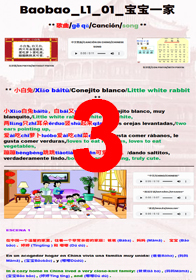
补充材料/Materiales adicionales/Additional Materials
PDF与视频/PDF y videos/PDF and Videos
边玩边学/Aprenda jugando/Learn by Playing
学习西班牙语/Aprenda Español/Learn Spanish
