** 09_她是医生/tā shì yīshēng/Ella es médica/She is a doctor **

课程视频/VIDEO DE LA LECCION/Lesson video
** 课文/kè wén/Textos/Texts **
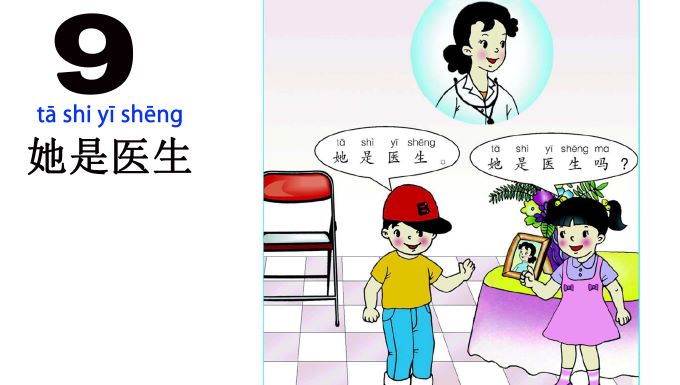
1) 小tā她shì是医生yīshēng/Ella es doctora/She is a doctor
2) 她tā是shì医生yīshēng吗ma?/¿Es ella médica?/Is she a doctor?
3) 她tā是shì医生yīshēng/Ella es médica/She is a doctor
场景视频/Video de la escena/ Scene video
中文/Chino/Chinese
西班牙语/Español/Spanish
英语/inglés/English
4) 读dú一yi读dú/Lee/Read
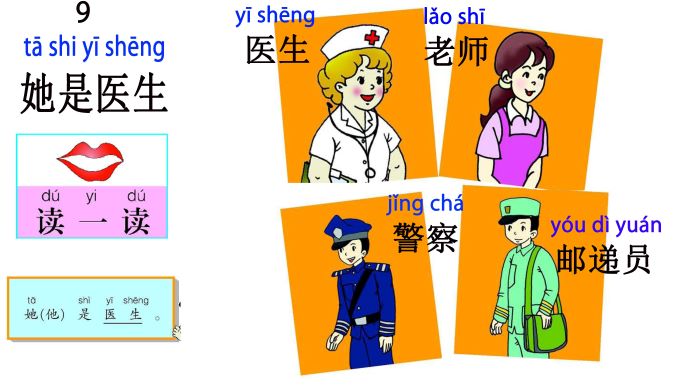
5) 她tā(他(tā))是shì医生yīshēng/Ella (él) es doctor(a)/She (he) is a doctor
6) 医生yīshēng/Doctor(a)/Doctor
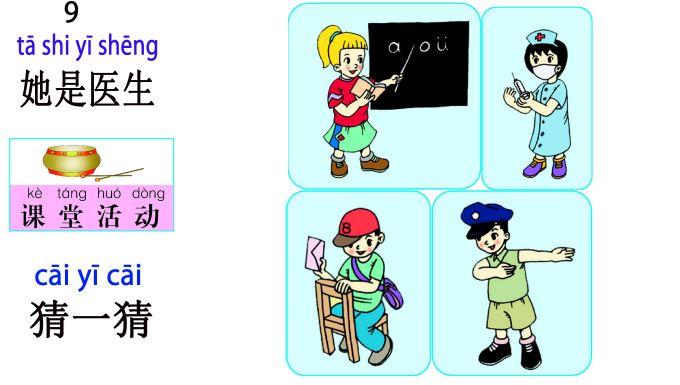
7) 老师lǎoshī/Profesor(a)/Teacher
8) 警察jǐngchá/Policía/Police officer
9) 邮递员yóudìyuán/Cartero/Mail carrier
中文/Chino/Chinese
西班牙语/Español/Spanish
英语/inglés/English
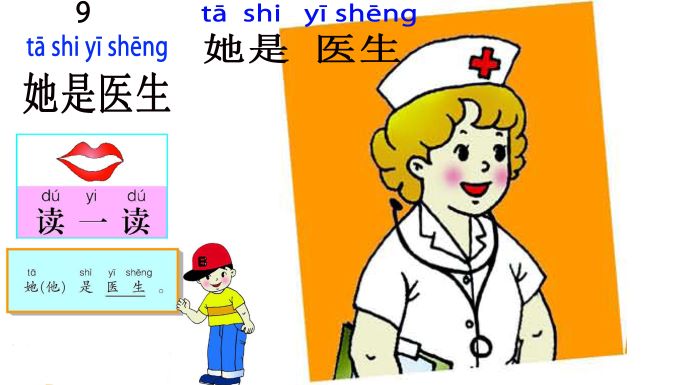
10) 她tā是shì医生yīshēng/Ella es doctora/She is a doctor
中文/Chino/Chinese
西班牙语/Español/Spanish
英语/inglés/English
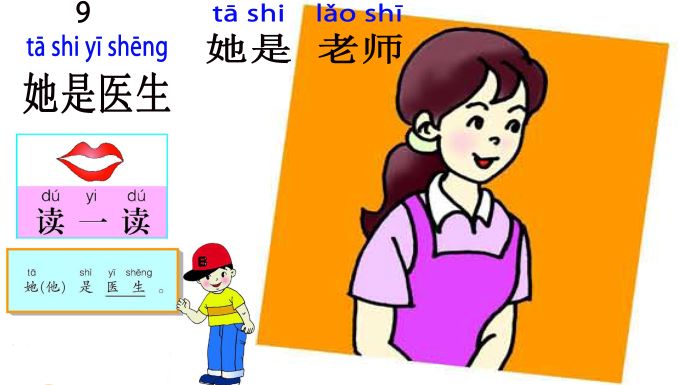
11) 她tā是shì老师lǎoshī/Ella es profesora/She is a teacher
中文/Chino/Chinese
西班牙语/Español/Spanish
英语/inglés/English
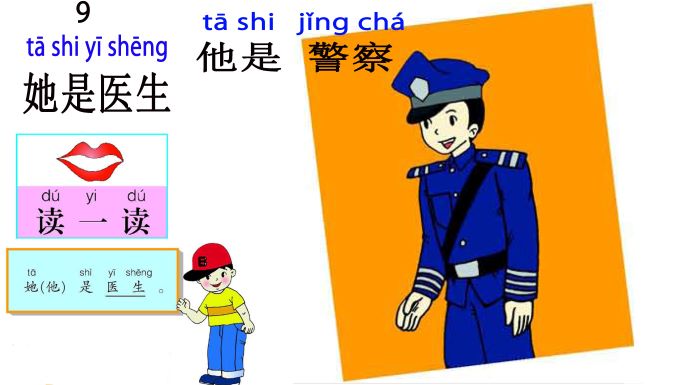
12) 他tā是shì警察jǐngchá/Él es policía/He is a police officer
中文/Chino/Chinese
西班牙语/Español/Spanish
英语/inglés/English
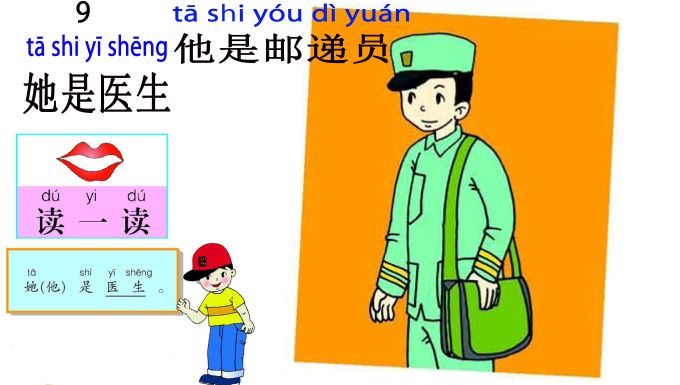
13) 他tā是shì邮递员yóudìyuán/Él es cartero/He is a mail carrier
中文/Chino/Chinese
西班牙语/Español/Spanish
英语/inglés/English
14) 说shuō一yi说shuō/Habla/Speak
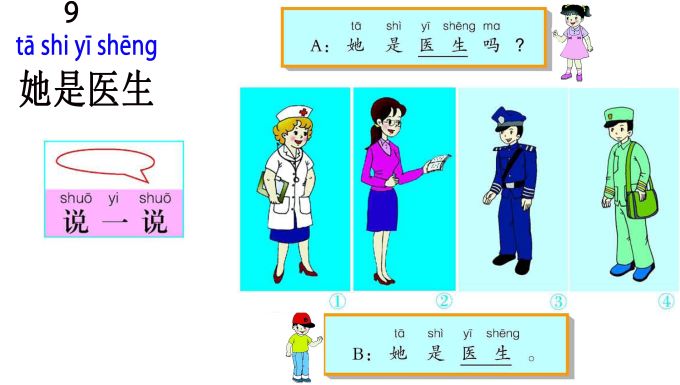
15) A:她Tā是shì医生yīshēng吗ma?/¿Es ella doctora?/Is she a doctor?
16) B:她Tā是shì医生yīshēng/Ella es doctora/She is a doctor
中文/Chino/Chinese
西班牙语/Español/Spanish
英语/inglés/English
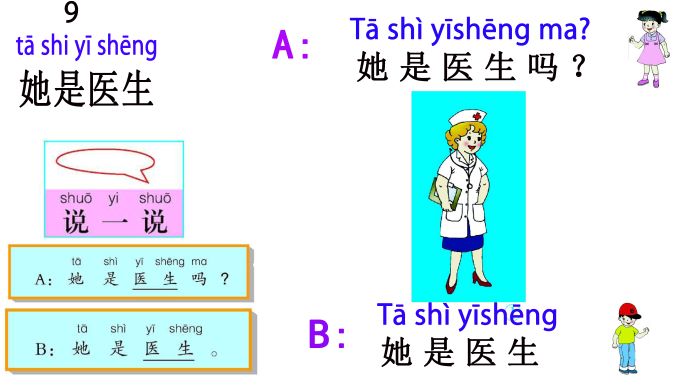
17) A:她Tā是shì医yīshēng生吗ma?/¿Es ella doctora?/Is she a doctor?
18) B:她Tā是shì医生yīshēng/Ella es doctora/She is a doctor
中文/Chino/Chinese
西班牙语/Español/Spanish
英语/inglés/English
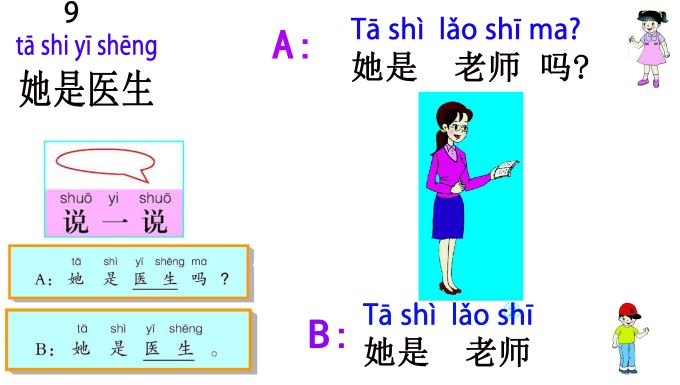
19) A:她Tā是shì老师lǎoshī吗ma?/¿Ella es profesora?/Is she a teacher?
20) B:她Tā是shì老师lǎoshī/Ella es profesora/She is a teacher
中文/Chino/Chinese
西班牙语/Español/Spanish
英语/inglés/English
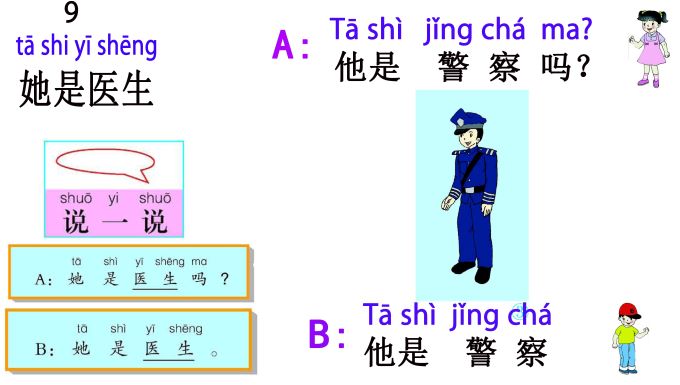
21) A:他Tā是shì警察jǐngchá吗ma?/¿Él es policía?/Is he a police officer?
22) B:他Tā是shì警察jǐngchá/Él es policía/He is a police officer
中文/Chino/Chinese
西班牙语/Español/Spanish
英语/inglés/English
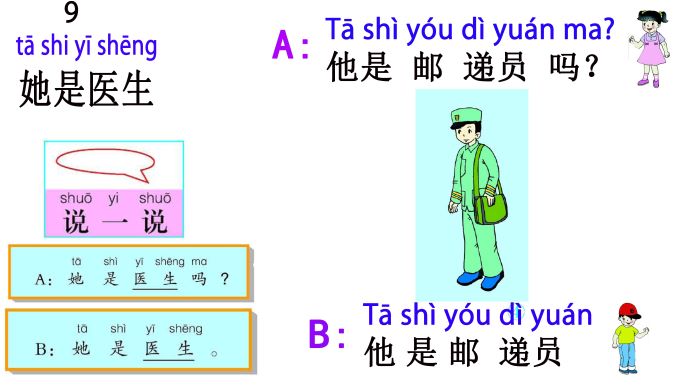
23) A:他Tā是shì邮递员yóudìyuán吗ma?/¿Él es cartero?/Is he a mail carrier?
24) B:他Tā是shì邮递员yóudìyuán/Él es cartero/He is a mail carrier
中文/Chino/Chinese
西班牙语/Español/Spanish
英语/inglés/English
4) 读dú一yi读dú/Lee/Read
5) 她tā(他(tā))是shì医生yīshēng/Ella (él) es doctor(a)/She (he) is a doctor
6) 医生yīshēng/Doctor(a)/Doctor
7) 老师lǎoshī/Profesor(a)/Teacher
8) 警察jǐngchá/Policía/Police officer
9) 邮递员yóudìyuán/Cartero/Mail carrier
中文/Chino/Chinese
西班牙语/Español/Spanish
英语/inglés/English
27) 课堂kètáng活动huódòng/Actividades en clase/Classroom activity
28) 猜cāi一yi猜cāi/Adivina/Guess
中文/Chino/Chinese
西班牙语/Español/Spanish
英语/inglés/English
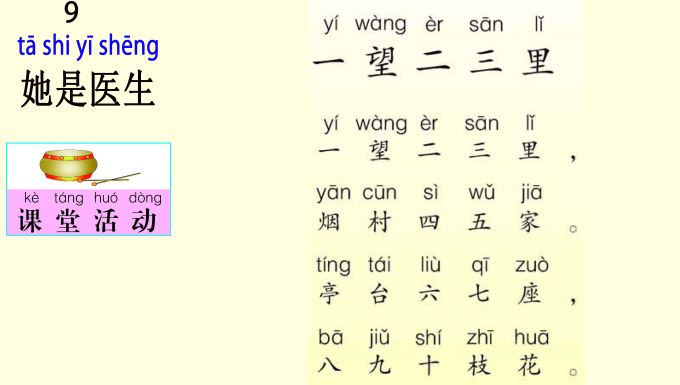
29) 儿歌érgē/Canción infantil/Nursery rhyme
30) 一Yī望wàng二èr三sān里lǐ/’Mira a dos o tres millas’ (poema)/’A distant view of 2-3 li’ (poem)
中文/Chino/Chinese
西班牙语/Español/Spanish
英语/inglés/English
** 部首/bù shǒu/Radical/Radical **
点击放大/clic para ampliar/click to enlarge
中文
Español
English
▶ 📝 评论 / Comentarios / Comments
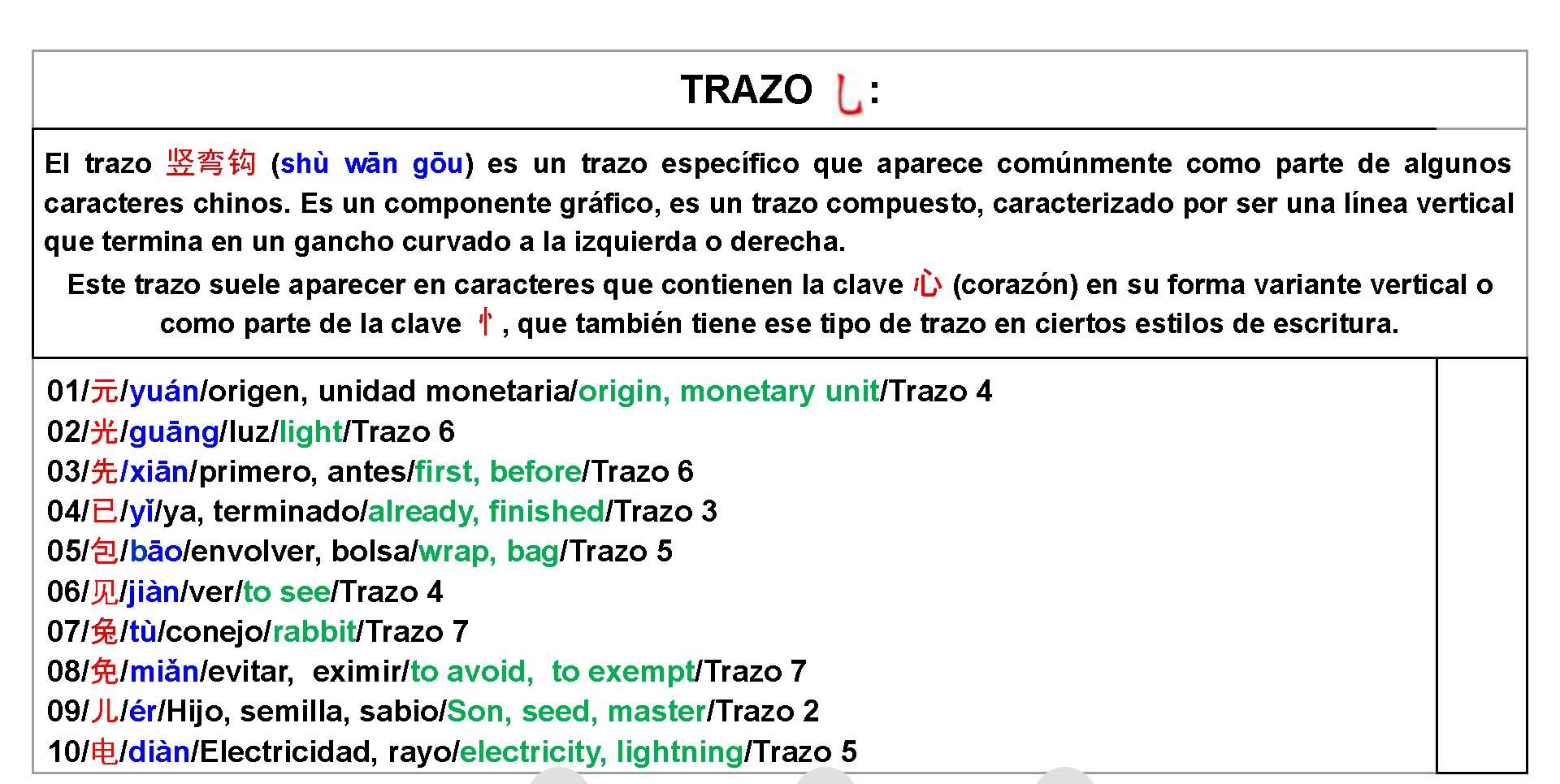
2. 圆滑的弯,而非折角: 与我们之前学的 ‘横折’ (héngzhé) (方形笔画)不同,这里没有生硬的折角。从垂直向水平的过渡必须圆润优雅,宛如天鹅的胸部。
3. 钩的方向: 到达水平线的末端时,小钩必须总是直接 向上(或微微指向汉字中心)挑出。
4. 压轴之笔: 在绝大多数包含该笔画的汉字中,如 儿、见 或 也,它通常是最后一笔。它就像一个优雅的收尾,将汉字右侧的结构闭合并且达到平衡。
2. Curva suave, no esquina: A diferencia del héngzhé (el trazo cuadrado que vimos en lecciones anteriores), aquí no hay un quiebre brusco. La transición de la línea vertical a la horizontal debe ser redondeada y elegante, como el pecho de un cisne.
3. Dirección del gancho: Al llegar al final de la línea horizontal, el pequeño gancho siempre debe apuntar directamente hacia arriba (o ligeramente apuntando hacia el centro del carácter).
4. El gran final: En la gran mayoría de los caracteres que lo contienen, como 儿 (hijo) , 见 (ver) o 也 (también) , este trazo se escribe en último lugar. Funciona como el toque de gracia que cierra y equilibra la estructura por su lado derecho.
2. Smooth curve, no sharp corner: Unlike the héngzhé (the square stroke we saw in previous lessons), there is no sharp break here. The transition from the vertical to the horizontal line must be rounded and elegant, like a swan's chest.
3. Direction of the hook: Upon reaching the end of the horizontal line, the small hook must always point straight up (or point slightly inwards towards the center of the character).
4. The grand finale: In the vast majority of characters that contain it, such as 儿 (son) , 见 (to see) , or 也 (also) , this stroke is written last. It acts as the graceful finishing touch that closes and balances the structure on its right side.
** 字符/zìfú/caracteres/characters **

AVI: 书写汉字/Escribir caracteres/ Writing Chinese characters
▶ 📝 评论 / Comentarios / Comments
2. 警察 (jǐngchá):由 ‘警戒’ (警) + ‘察看’ (察) 组成。负责警戒并巡察的人!
3. 邮递员 (yóudìyuán):非常具象:‘邮政’ (邮) + ‘传递’ (递) + ‘人员’ (员) 。传递信件的员工!
2. 警察 (jǐngchá): Se forma uniendo ‘alerta/policía’ (警) + ‘inspeccionar’ (察) . ¡El que vigila e inspecciona!
3. 邮递员 (yóudìyuán): Es muy descriptivo: ‘correo/postal’ (邮) + ‘entregar’ (递) + ‘empleado’ (员) . ¡El empleado que entrega el correo!
2. 警察 (jǐngchá): It is formed by combining ‘alert/police’ (警) + ‘to inspect’ (察) . The one who watches and inspects!
3. 邮递员 (yóudìyuán): It is very descriptive: ‘mail/postal’ (邮) + ‘to deliver’ (递) + ‘employee’ (员) . The employee who delivers the mail!
** 词汇/cí huì/Vocabulario/Vocabulary **

AVI: 词汇/Vocabulario/Vocabulary
中文/Chino/Chinese
西班牙语/Español/Spanish
英语/inglés/English

AVI: 听与重复/Escucha y repite/Listen and repeat
▶ 📝 评论 / Comentarios / Comments
2. 拼音的分词连写: 在现代标准汉语中,复合词的拼音是连写的。例如,lǎo shī 拼写为 lǎoshī,yī shēng 拼写为 yīshēng,yóu dì yuán 拼写为 yóudìyuán。这极大地帮助了学生识别哪些音节组成了一个完整的单词。
3. ’一’ (yi) 的规则一致性: 在第6项 (说一说) ,拼音改为了中间读轻声的 cāi yi cāi,这遵循了我们之前学过的关于动词重叠时的语音规则。
4. 现代西班牙语正字法: ‘2 ó 3’ 改为了 ‘2 o 3’。根据西班牙皇家语言学院 (RAE) 的现行规范,数字之间的连词 ‘o’ 不再加重音符号,因为在现代排版中它已不再有与数字零混淆的风险。
2. Agrupación del pinyin: En el chino moderno estándar, las palabras compuestas se escriben juntas en pinyin. Por ejemplo, lǎo shī pasa a ser lǎoshī, yī shēng a yīshēng, y yóu dì yuán a yóudìyuán. Esto ayuda mucho a los alumnos a identificar qué sílabas forman una sola palabra.
3. Consistencia en ‘一’ (yi) : En los ítems 6 (说一说) se cambia el pinyin a cāi yi cāi con tono neutro en el medio, respetando la regla fonética que ya hemos aprendido sobre los verbos duplicados.
4. Ortografía moderna (Español): ‘2 ó 3’ por ‘2 o 3’. Según la normativa actual de la RAE, la conjunción ‘o’ ya no lleva tilde entre números porque ya no hay riesgo de confundirla con un cero en las tipografías modernas.
2. Pinyin grouping: In standard modern Chinese, compound words are written together in pinyin. For example, lǎo shī becomes lǎoshī, yī shēng becomes yīshēng, and yóu dì yuán becomes yóudìyuán. This greatly helps students identify which syllables form a single word.
3. Consistency of ‘一’ (yi) : In item 6 (说一说) , the pinyin is changed to cāi yi cāi with a neutral tone in the middle, respecting the phonetic rule we have already learned about duplicated verbs.
4. Modern Spanish orthography: ‘2 ó 3’ to ‘2 o 3’. According to the current RAE regulations, the conjunction ‘o’ no longer carries an accent mark between numbers because there is no longer a risk of confusing it with a zero in modern typography.
** 目录/mù lù/Indice de la página/Table of contents **
课文/Textos/Texts
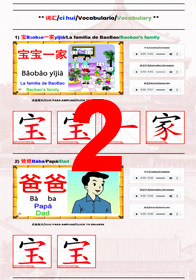
词汇/Vocabulario/Vocabulary
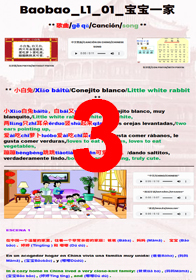
补充材料/Materiales adicionales/Additional Materials

PDF与视频/PDF y videos/PDF and Videos
边玩边学/Aprenda jugando/Learn by Playing
学习西班牙语/Aprenda Español/Learn Spanish
