
** 05_再见/zàijiàn/Adiós/Goodbye **

点击放大/clic para ampliar/click to enlarge

点击放大/clic para ampliar/click to enlarge

AVI: 词汇/Vocabulario/Vocabulary
** 词汇/cí huì/Vocabulario/Vocabulary **
1) 再见zàijiàn/Adiós/Goodbye

点击放大/clic para ampliar/click to enlarge
中文/Chino/Chinese
西班牙语/Español/Spanish
英语/inglés/English
2) 点diǎn/Trazo de punto/Dot stroke

点击放大/clic para ampliar/click to enlarge
中文/Chino/Chinese
西班牙语/Español/Spanish
英语/inglés/English
** 部首/bù shǒu/Radical/Radical **
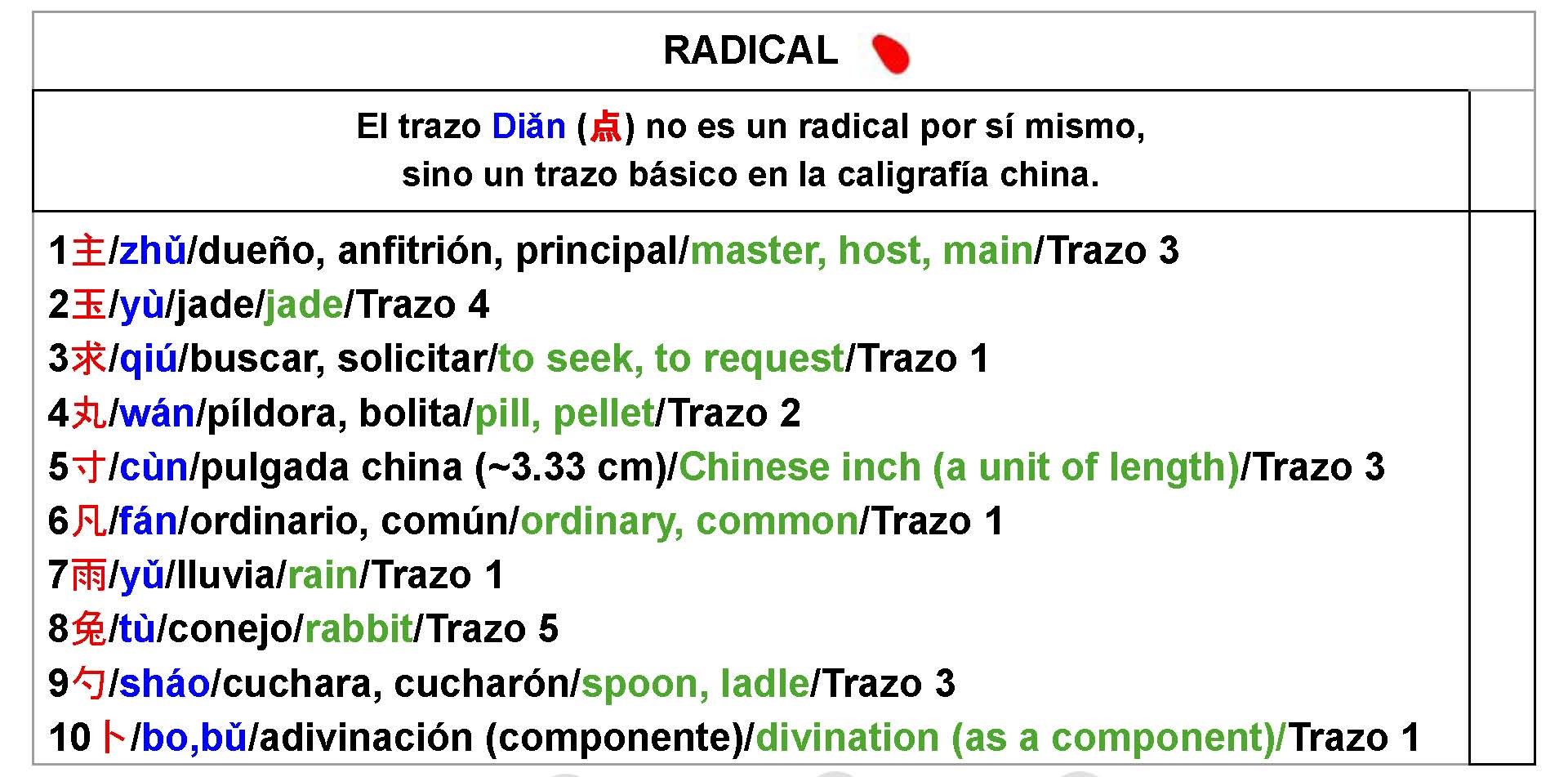
点击放大/clic para ampliar/click to enlarge
中文
Español
English
▶ 📝 评论 / Comentarios / Comments
2. 四点底(灬): 当我们在汉字底部看到连续的四个点时(如在’热’或’黑’中),它们构成了偏旁 ’灬’(sìdiǎn dǐ)。重要的是要知道这个偏旁是’火’的变形,因此它通常出现在与热或烹饪相关的汉字中。
3. 语法用法(’一点’): 作为词语,’点’常用于动词或形容词之后,表示’一点’或少量(例如:吃点 - chī diǎn ;快点 - kuài diǎn)。
4. 表示时间: ‘点’也是中文里表示时间的关键字,相当于’点钟’(例如:两点 - liǎng diǎn)。
2. El radical de los cuatro puntos (灬): Cuando encontramos cuatro puntos seguidos en la parte inferior de un carácter (como en 热 – calor, o 黑 – negro), forman el radical (‘灬’ (sìdiǎn dǐ)). Es importante saber que este radical es una variante de ‘fuego’ (火), por lo que suele aparecer en caracteres relacionados con el calor o la cocción.
3. Uso gramatical (‘un poco’): Como palabra, ‘点’ se usa frecuentemente después de verbos o adjetivos para indicar ‘un poco’ o una cantidad pequeña (ej: 吃点 - chī diǎn, comer un poco; 快点 - kuài diǎn, un poco más rápido).
4. Para decir la hora: ‘点’ también es la palabra clave para dar la hora en chino, funcionando como ‘en punto’ (ej: 两点 - liǎng diǎn, las dos en punto).
2. The four-dot radical (灬): When we find four consecutive dots at the bottom of a character (as in 热 – hot, or 黑 - black), they form the radical ‘灬’ (sìdiǎn dǐ). It is important to know that this radical is a variant of ‘fire’ (火), so it often appears in characters related to heat or cooking.
3. Grammatical use (‘a little’): As a word, ‘点’ is frequently used after verbs or adjectives to indicate ‘a little bit’ or a small amount (e.g., 吃点 - chī diǎn, eat a little; 快点 - kuài diǎn, a little faster).
4. Telling time: ‘点’ is also the key word for telling time on the clock, meaning ‘o'clock’ (e.g., 两点 - liǎng diǎn, two o'clock).
2) 没关系méiguānxi/No importa/It's okay
点击放大/clic para ampliar/click to enlarge
中文/Chino/Chinese
西班牙语/Español/Spanish
英语/inglés/English
4) 再见zàijiàn/Adiós/Goodbye

点击放大/clic para ampliar/click to enlarge
中文/Chino/Chinese
西班牙语/Español/Spanish
英语/inglés/English
** 字/zì/Caracteres/Characters **
(次/veces/times:1,2,3,4,5,6,7,8,9)
了解更多信息,请点击汉字。 Para más información clik en el Hanzi. For more information, click on the Hanzi.
汉字的音频/Audio de los Hanzi/Audio of the Hanzi
** 词汇/cí huì/Vocabulario/Vocabulary **
AVI: 词汇/Vocabulario/Vocabulary
中文/Chino/Chinese
西班牙语/Español/Spanish
英语/inglés/English

AVI: 听与重复/Escucha y repite/Listen and repeat
▶ 📝 评论 / Comentarios / Comments
2. 找朋友 (zhǎo péngyou):最后一个音节 (you) 读轻声,并且保留 ‘Buscar amigos / Looking for friends’ 作为动词 找 (zhǎo,寻找) 最准确的翻译。
2. 找朋友 (zhǎo péngyou): Se aplica el tono neutro en la última sílaba (you), y se mantiene ‘Buscar amigos / Looking for friends’ como la traducción más precisa para el verbo 找 (zhǎo, buscar).
2. 找朋友 (zhǎo péngyou): The neutral tone is applied to the last syllable (you), and ‘Buscar amigos / Looking for friends’ is maintained as the most accurate translation for the verb 找 (zhǎo, to look for).
** 目录/mù lù/Indice de la página/Table of contents **
课文/Textos/Texts
词汇/Vocabulario/Vocabulary
补充材料/Materiales adicionales/Additional Materials

PDF与视频/PDF y videos/PDF and Videos
边玩边学/Aprenda jugando/Learn by Playing
学习西班牙语/Aprenda Español/Learn Spanish
