** 02_你好/Nǐ hǎo/Hola/Hello **

课程视频/VIDEO DE LA LECCION/Lesson video
** 课文/kè wén/Textos/Texts **
1) 你Nǐ好hǎo/Hola/Hello
2) 你Nǐ好hǎo/Hola/Hello
3) 你Nǐ好hǎo/Hola/Hello

场景视频/Video de la escena/ Scene video
中文/Chino/Chinese
西班牙语/Español/Spanish
英语/inglés/English
4) 读Dú一yi读dú/Leer/Read
5) 爸爸Bàba/Papá/Dad
6) 妈妈Māmā/Mamá/Mom
7) 宝宝Bǎobǎo/Baobao/Bao Bao
8) 老师Lǎoshī/Profesora/Teacher

中文/Chino/Chinese
西班牙语/Español/Spanish
英语/inglés/English
9) 爸爸Bàba好hǎo/Hola Papá/Hello dad

中文/Chino/Chinese
西班牙语/Español/Spanish
英语/inglés/English
10) 妈妈Māmā好hǎo/Hola Mamá/Hello mom

中文/Chino/Chinese
西班牙语/Español/Spanish
英语/inglés/English
11) 宝宝Bǎobǎo好hǎo/Hola Baobao/Hello Baobao

中文/Chino/Chinese
西班牙语/Español/Spanish
英语/inglés/English
12) 老师Lǎoshī好hǎo/Hola profesora/Hello teacher

中文/Chino/Chinese
西班牙语/Español/Spanish
英语/inglés/English
13) 说Shuō一yī说shuō/Responde/Reply
14) 你Nǐ好hǎo¡!/Hola ¡/Hello¡
15) 你Nǐ好hǎo¡!/Hola ¡/Hello¡

中文/Chino/Chinese
西班牙语/Español/Spanish
英语/inglés/English
16) A:你Nǐ好hǎo¡!/Hola ¡/Hello¡
17) B:你Nǐ好hǎo¡!/Hola ¡/Hello¡

中文/Chino/Chinese
西班牙语/Español/Spanish
英语/inglés/English
18) A:你Nǐ好hǎo¡!/Hola ¡/Hello¡
19) B:你Nǐ好hǎo¡!/Hola ¡/Hello¡

中文/Chino/Chinese
西班牙语/Español/Spanish
英语/inglés/English
20) A:你Nǐ好hǎo¡!/Hola ¡/Hello¡
21) B:宝宝Bǎobǎo好hǎo/Hola Baobao/Hello Baobao

中文/Chino/Chinese
西班牙语/Español/Spanish
英语/inglés/English
22) A:妈妈Māmā好hǎo/Hola Mamá/Hello mom
23) B:你Nǐ好hǎo¡!/Hola ¡/Hello¡

中文/Chino/Chinese
西班牙语/Español/Spanish
英语/inglés/English
24) 写Xiě一yi写xiě/Escribe/Write
25) 竖Shù/Trazo Vertical/Vertical stroke

中文/Chino/Chinese
西班牙语/Español/Spanish
英语/inglés/English
26) 课堂Kètáng活动huódòng/Juegos de clase/Classroom activities
27) 打Dǎ招呼zhāohū/Saludar/Greet

中文/Chino/Chinese
西班牙语/Español/Spanish
英语/inglés/English
28) 儿歌érgē/Canción infantil/Nursery rhyme
29) 你Nǐ好hǎo/Hola/Hello

中文/Chino/Chinese
西班牙语/Español/Spanish
英语/inglés/English
** 部首/bù shǒu/Radical/Radical **
中文
Español
English
点击放大/clic para ampliar/click to enlarge
中文
Español
English
▶ 📝 评论 / Comentarios / Comments
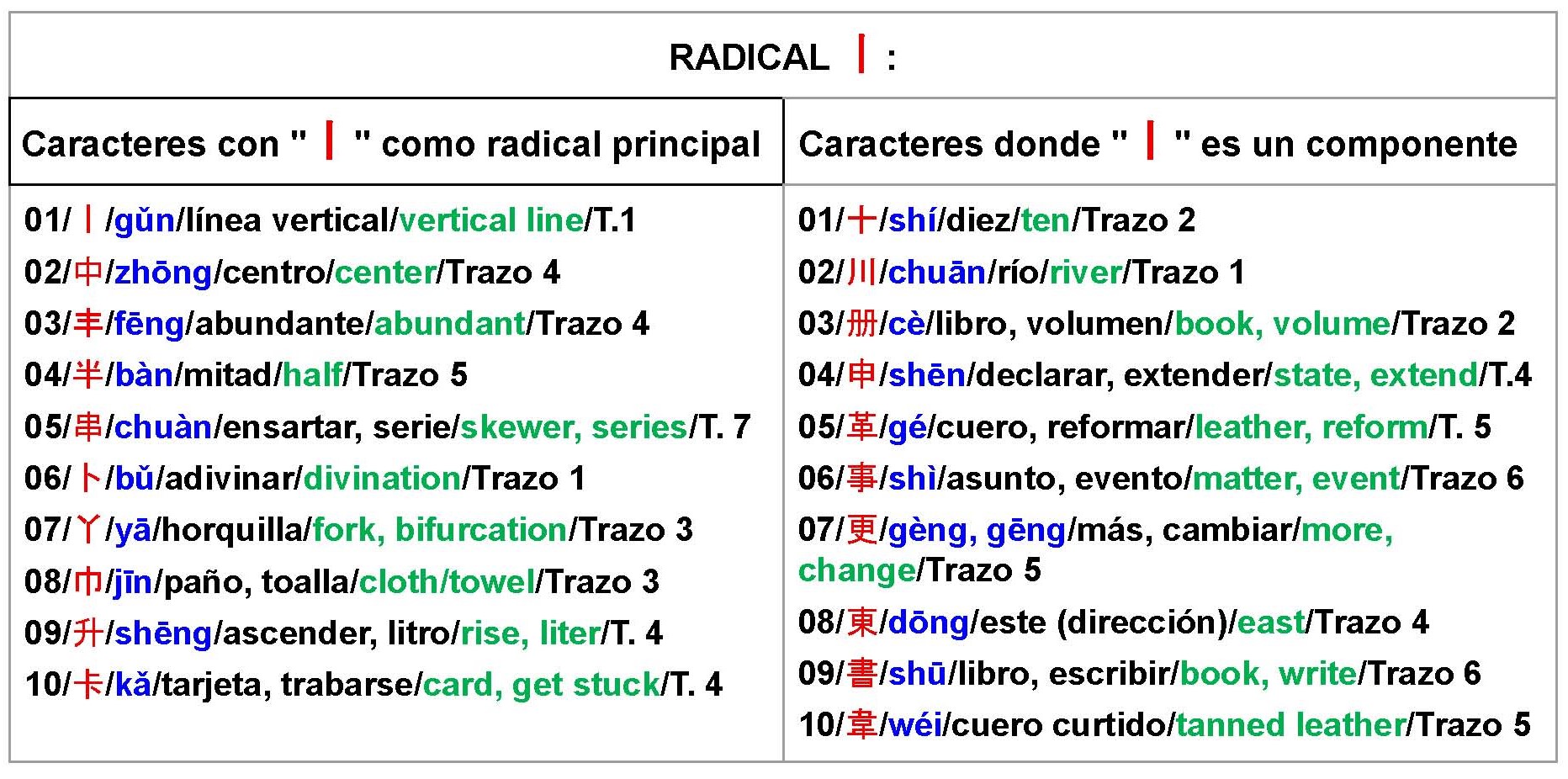
• ‘中流砥柱:’ 在许多汉字中,这个笔画就像’脊椎’一样,支撑并赋予整个’结构对称性’(我们在’中’或’十’中可以清楚地看到)。
• ‘两种收笔方式:’ 在书法中,这个笔画主要有两种收笔方式:一种是收笔尖锐出锋(被称为’悬针竖’);另一种是收笔平缓圆润(被称为’垂露竖’)。
• ‘笔顺规则:’ 汉字书写最基本的规则之一是 ’先横后竖’(xiān héng hòu shù)。因此,如果一条竖线穿过一条横线(如在’十’中),竖线总是后写。
• ‘La columna vertebral:’ En muchísimos caracteres, este trazo funciona como el pilar central que sostiene y da simetría a toda la estructura (como vemos de forma muy clara en 中 - centro, o 十 - diez).
• ‘Dos estilos finales: ‘En la caligrafía, existen dos formas principales de terminar este trazo: una terminando en una punta afilada (conocida como ‘悬针竖’ aguja suspendida) y otra terminando de forma suave y redondeada (‘垂露竖’ - gota de rocío).
• ‘Regla del orden de los trazos:’ Una de las reglas más básicas de la escritura china es ‘primero el horizontal, luego el vertical’ (先横后竖 - xiān héng hòu shù). Por lo tanto, si un trazo vertical cruza a uno horizontal (como en 十), el vertical siempre se escribe en segundo lugar.
• ‘The central pillar:’ In many characters, this stroke functions as the spine that supports and gives symmetry to the entire structure (as clearly seen in 中 - center, or 十 - ten).
• ‘Two ending styles:’ In calligraphy, there are two main ways to finish this stroke: one ending in a sharp point (known as ‘悬针竖’ - suspended needle) and the other ending softly with a rounded tip (‘垂露竖’ - hanging dewdrop).
• ‘Stroke order rule:’ One of the most basic rules of Chinese writing is ‘horizontal first, then vertical’ (先横后竖- xiān héng hòu shù). Therefore, if a vertical stroke crosses a horizontal one (as in 十), the vertical stroke is always written second.
** 字符/zìfú/caracteres/characters **

AVI: 书写汉字/Escribir caracteres/ Writing Chinese characters
▶ 📝 评论 / Comentarios / Comments
• 动词的重叠 (Dòngcí de chóngdié): 像 说一说 (shuō yī shuō) 这样的结构是中文里一个非常有趣且常用的语法点。重复一个动词并在中间加上‘一 (yī - 一)’,可以软化语气,表示动作时间很短或很轻松,字面意思是‘说一说/聊一聊’。
• 尊师重道 (Zūn shī zhòng dào): 在中国文化中,教师是非常受尊敬的。(老师 (Lǎoshī))) 不仅仅是一个职业名词,它本身就被当作一个称呼或头衔来使用。学生们通常不会直接叫老师的名字,而是直接称呼他们’老师’或’老师好!’(老师您好!)。
• La reduplicación de verbos: La estructura 说一说 (shuō yī shuō) es un patrón gramatical muy interesante y común en el chino. Repetir un verbo con un ‘一 (yī - uno)’ en medio suaviza el tono de la frase, indicando que la acción es breve o relajada, como ‘hablar un poquito’ o ‘dar una charladita’.
• El respeto al maestro: En la cultura china, la figura del profesor es sumamente respetada. 老师 (Lǎoshī) no es solo el nombre de la profesión, sino que se usa directamente como título o pronombre. Los estudiantes rara vez usan el nombre de pila del profesor; simplemente le llaman ‘¡Profesor!’ o lo usan para saludar: ‘老师好!’ (¡Hola, profesor!).
• Verb reduplication: The structure 说一说 (shuō yī shuō) is a very interesting and common grammatical pattern in Chinese. Repeating a verb with a ‘一 (yī - one)’ in the middle softens the tone of the sentence, indicating that the action is brief or relaxed, meaning ‘to talk a little’ or ‘to have a quick chat’.
• Respect for the teacher: In Chinese culture, the figure of the teacher is highly respected. 老师 (Lǎoshī) is not just the name of the profession; it is used directly as a title or pronoun. Students rarely use a teacher's first name; they simply call them ‘Teacher!’ or use it as a greeting: ‘老师好!’ (Hello, teacher!) .
** 词汇/cí huì/Vocabulario/Vocabulary **

AVI: 词汇/Vocabulario/Vocabulary
中文/Chino/Chinese
西班牙语/Español/Spanish
英语/inglés/English

AVI: 听与重复/Escucha y repite/Listen and repeat
▶ 📝 评论 / Comentarios / Comments
• 动词的重叠 (Dòngcí de chóngdié): 像 说一说 (shuō yī shuō) 这样的结构是中文里一个非常有趣且常用的语法点。重复一个动词并在中间加上‘一 (yī - 一)’,可以软化语气,表示动作时间很短或很轻松,字面意思是‘说一说/聊一聊’。
• 尊师重道 (Zūn shī zhòng dào): 在中国文化中,教师是非常受尊敬的。(老师 (Lǎoshī))) 不仅仅是一个职业名词,它本身就被当作一个称呼或头衔来使用。学生们通常不会直接叫老师的名字,而是直接称呼他们’老师’或’老师好!’(老师您好!)。
• La reduplicación de verbos: La estructura 说一说 (shuō yī shuō) es un patrón gramatical muy interesante y común en el chino. Repetir un verbo con un ‘一 (yī - uno)’ en medio suaviza el tono de la frase, indicando que la acción es breve o relajada, como ‘hablar un poquito’ o ‘dar una charladita’.
• El respeto al maestro: En la cultura china, la figura del profesor es sumamente respetada. 老师 (Lǎoshī) no es solo el nombre de la profesión, sino que se usa directamente como título o pronombre. Los estudiantes rara vez usan el nombre de pila del profesor; simplemente le llaman ‘¡Profesor!’ o lo usan para saludar: ‘老师好!’ (¡Hola, profesor!).
• Verb reduplication: The structure 说一说 (shuō yī shuō) is a very interesting and common grammatical pattern in Chinese. Repeating a verb with a ‘一 (yī - one)’ in the middle softens the tone of the sentence, indicating that the action is brief or relaxed, meaning ‘to talk a little’ or ‘to have a quick chat’.
• Respect for the teacher: In Chinese culture, the figure of the teacher is highly respected. 老师 (Lǎoshī) is not just the name of the profession; it is used directly as a title or pronoun. Students rarely use a teacher's first name; they simply call them ‘Teacher!’ or use it as a greeting: ‘老师好!’ (Hello, teacher!).
** 目录/mù lù/Indice de la página/Table of contents **
课文/Textos/Texts
词汇/Vocabulario/Vocabulary
补充材料/Materiales adicionales/Additional Materials

PDF与视频/PDF y videos/PDF and Videos
边玩边学/Aprenda jugando/Learn by Playing
学习西班牙语/Aprenda Español/Learn Spanish
